
Key takeaways:
- The difference between mediocrity and greatness has never been the absence of missteps. It’s the willingness to keep leaning into the ideas that have the power to move forward.
- Inefficient meetings are the single biggest obstacle to productivity, and “having too many meetings” ranks third.
- Great organizations don’t just meet more efficiently, they meet with intent - they treat every meeting as an investment of time, attention, and energy.
In this post:
Share this post:
A few years ago, during a roundtable promoting the movie Air, Matt Damon shared something Ben Affleck told him back when they were writing Good Will Hunting:
“Judge me for how good my good ideas are, not how bad my bad ideas are.”
That line stayed with me. It’s a reminder that creativity, leadership, and meaningful partnership all come from a place of possibility – not perfection.
Too often, we evaluate work by what didn’t land, what could have been sharper, what missed the mark. We can easily find ourselves focusing on the gap instead of the gain. Yes, reflection is valuable. Yes, learning matters. But progress – real, sustainable progress – happens when we invest our energy in what is working and allow those ideas to grow.
The best ideas rarely arrive polished. They evolve through trust, collaboration, and the courage to offer something new, even when not every idea will be the one that advances the story. The difference between mediocrity and greatness has never been the absence of missteps. It’s the willingness to keep leaning into the ideas that have the power to move us forward.
At Integreon, that mindset is foundational. Our teams and our clients co-create environments where strong ideas can emerge, take shape, and scale. We don’t dwell on the imperfect – we capture lessons, build on strengths, and amplify what works. We nurture partnerships that invite curiosity, celebrate innovation, and make room for continuous momentum.
That’s how small sparks turn into meaningful impact. Not by avoiding mistakes, but by elevating the good and letting it lead.
Greatness isn’t the absence of error. Greatness is recognizing what’s right and having the conviction to champion it.
So maybe the real question for all of us is this: How boldly are we lifting up the good ideas — our own, and those of the people around us?
Keep championing what’s great.

Could this have been an email?
Dealing with Meeting Overload
Communication is critical for any business. Without regular team discussions and idea-sharing sessions, it’s hard to set strategies, evaluate work efforts, and make progress toward goals.
But any executive will tell you, sometimes there are simply too many meetings. If you have a high level of responsibility in your role, it’s not uncommon to find yourself attending a constant stream of check-ins, stand-ups, reviews, weeklies, one-on-ones, all-hands, and kick-offs that make you start to wonder when the real work gets done.
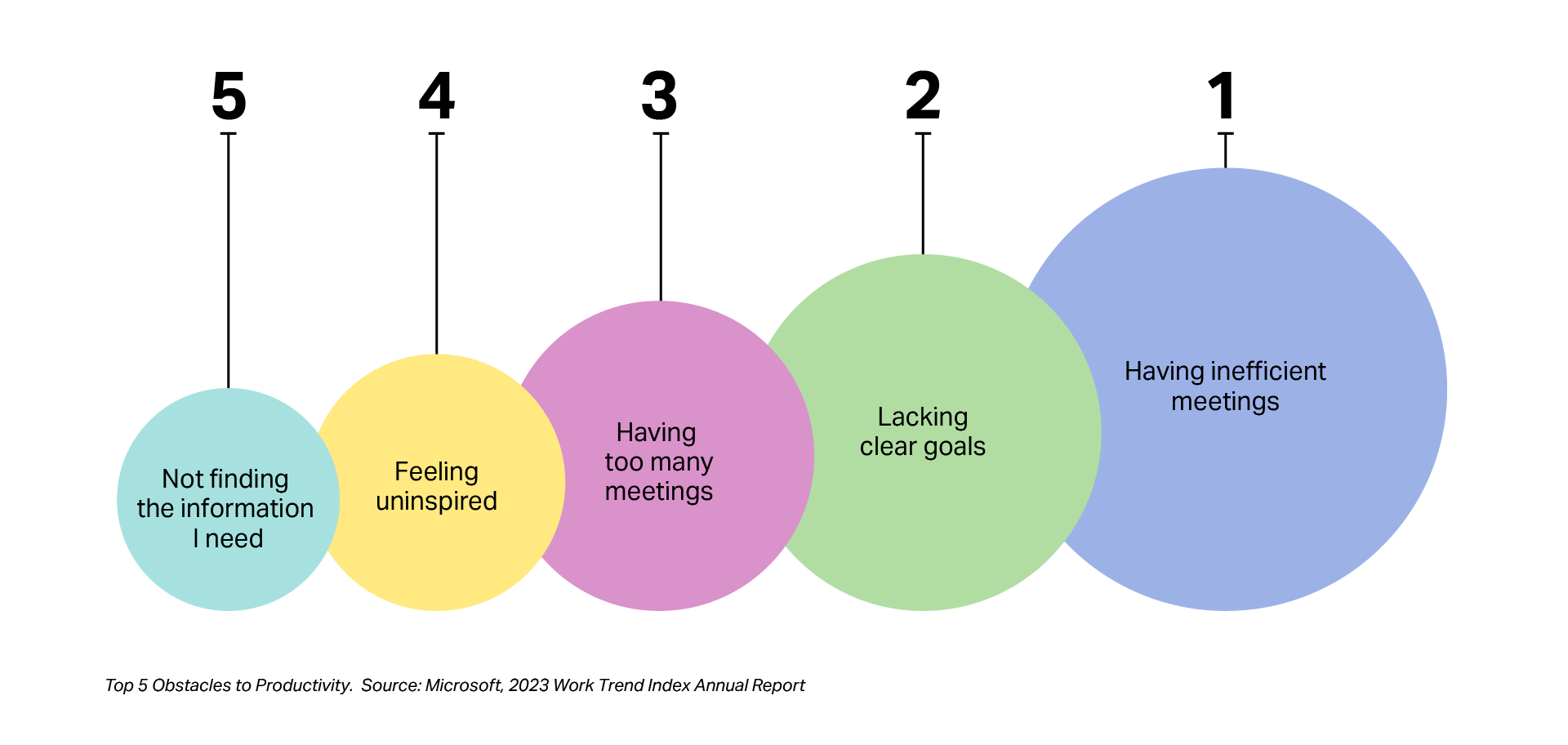
And are these regular get-togethers achieving much for firms? Maybe not. A large-scale 2023 study by Microsoft found that “inefficient meetings” were the single biggest obstacle to productivity, while “having too many meetings” ranked third. And while most organizations wouldn’t want to eliminate meetings entirely, these findings make one thing clear – there’s plenty of room for improvement.
Top 5 obstacles to productivity
Technology adds another layer of complexity. Another 2023 study from researchers in Austria found that digital meetings, while convenient, come with a cognitive cost: videoconferencing tools such as Microsoft Teams, Google Meet, and Zoom increase mental fatigue compared with face-to-face interaction.
Solutions to this issue will vary from firm to firm. Some may need to reduce the total number of meetings, while others may need to improve the quality and structure of the ones they keep.
A few practical steps to make a major difference
- Cut the clutter. Start by asking whether every meeting is truly necessary. Research from Bain & Company found that the average organization loses over 20% of its productive capacity to “organizational drag” – unnecessary processes and meetings that slow work down. Reducing or eliminating recurring check-ins with unclear objectives can reclaim meaningful time and focus.
- Rethink who’s in the room. Smaller, more focused meetings drive better decisions. Limit attendance to those who play a role in the outcome and use asynchronous updates or AI-generated summaries to keep others informed without pulling them away from their work.
- Respect the clock. Shorter meetings sharpen focus. Set clear time limits (even for complex topics) and end early when possible. The goal is alignment and accountability, not endurance.
- Use technology strategically. Digital tools can enhance collaboration, but too much screen time drains focus. Balance live interaction with other tools like shared dashboards, recorded briefings, or written updates.
- Build diverse participation. Research from the London School of Economics found that meetings including participants from multiple age cohorts were 32% more likely to deliver measurable productivity gains than those with less generational diversity. Mixing perspectives across experience levels, geographies, and roles consistently leads to richer thinking and stronger results.
Ultimately, great organizations don’t just meet more efficiently, they meet with intent. They treat every meeting as an investment of time, attention, and energy. When those resources are spent deliberately, the result isn’t just fewer meetings – it’s better ones. And better meetings lead to clearer decisions, stronger teams, and the kind of collaboration that sustains greatness over time.