

Key takeaways:
- Generative AI has made polished, authoritative-sounding content easy to produce, meaning sounding like an expert is no longer proof of expertise.
- As expertise signals become commoditized, value shifts from producing content to producing genuine perspective and original thinking.
- 73% of decision-makers trust thought leadership more than marketing materials, and audiences want transparency about AI-generated content.
- Real thought leaders differentiate through four traits: original perspective, evidence and insight, transparency, and consistency, proving an expertise AI cannot manufacture.
Share this post:
Subscribe:
Get the latest news and insights from Integreon delivered to your inbox.
Generative AI has changed the rules of content creation. Today, anyone can produce polished articles, professional graphics, and seemingly authoritative analysis in a matter of minutes. For business leaders, marketers, and subject matter experts, that’s both a remarkable opportunity and a growing challenge.
Because for the first time, sounding like an expert is no longer proof of expertise.
From AI-generated social media trends and educational tools to advertising campaigns built largely with machine-generated assets, content is being created at an unprecedented scale. The barriers to publishing have never been lower, and the volume of information competing for attention has never been higher.
The result is a new reality: expertise signals are becoming increasingly commoditized. When everyone can produce content that looks credible, audiences need new ways to determine who is actually credible.
The rise of “expertise inflation”
The challenge isn’t that AI creates bad content.
In many cases, it creates content that is clear, well-structured, and informative. The challenge is that it can also generate content that appears thoughtful without offering original thinking.
As AI accelerates content production, readers are becoming more discerning. They are learning to look beyond polished language and professional formatting. Instead, they’re asking harder questions:
- Is there a genuine point of view here?
- Does this perspective reflect real-world experience?
- Is the author offering new insight or simply summarizing what already exists?
In other words, the value has shifted from producing content to producing perspective.
That’s why organizations that rely solely on volume may find themselves struggling to stand out, while those that consistently bring fresh ideas, informed analysis, and practical experience can differentiate themselves more effectively than ever before.
Trust has become the scarcer resource
This shift is particularly important because buyers and decision-makers have always valued expertise, but now they are placing an even greater premium on trust.
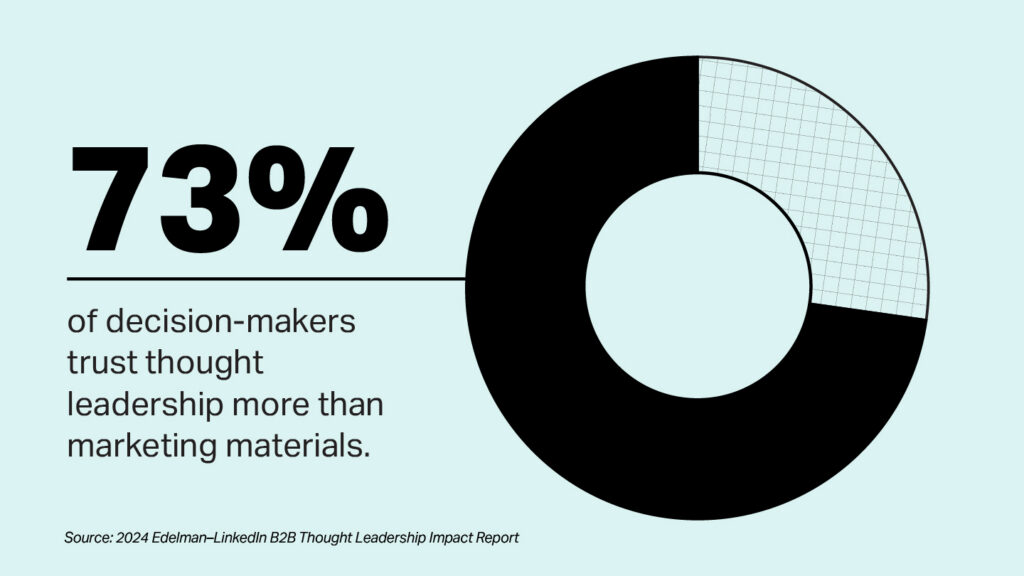
According to Edelman and LinkedIn’s 2024 B2B Thought Leadership Impact Report, 73% of decision-makers trust thought leadership more than marketing materials when judging an organization’s abilities. Furthermore, organizations that consistently produce high-quality thought leadership are more likely to influence purchasing decisions and attract serious consideration. Research from Getty Images reinforces this trend. Nearly nine out of ten consumers say transparency around AI-generated content is important, highlighting a growing demand for authenticity and accountability.
The message is clear: audiences are not simply looking for more content. They are looking for confidence in the source behind it.
How real thought leaders stand out
In an environment flooded with content, credibility becomes a competitive advantage. The organizations and individuals that successfully build influence tend to focus on four areas.
Original Perspective
They bring a point of view that cannot be replicated through prompts alone. Whether it’s a unique interpretation of industry developments, firsthand experience solving client challenges, or an informed prediction about what’s ahead, they contribute something genuinely new to the conversation.
Evidence and Insight
They support opinions with data, examples, and clear reasoning. Readers are more likely to trust perspectives that demonstrate how conclusions were reached rather than simply presenting conclusions themselves.
Transparency
They are open about their sources, methods, and assumptions. Transparency builds confidence and strengthens credibility, particularly in an era when audiences are increasingly evaluating the origins of information.
Consistency
They develop a recognizable voice and a reliable perspective over time. Trust is rarely built through a single article. It is earned through repeated delivery of valuable, relevant insights.
The future of thought leadership isn't more content
The good news is that AI has not replaced the need for expertise. If anything, it has amplified its importance. People will always seek out voices they trust. They will continue to follow analysts whose judgments they respect, leaders whose perspectives help them navigate uncertainty, and experts who consistently provide clarity amid complexity.
AI can help anyone create content.
It cannot manufacture experience.
It cannot replicate judgment.
And it cannot replace a perspective earned through years of solving real-world problems. When everyone can sound like an expert, the thought leaders and organizations that stand out will be the ones that can prove they really are experts.
At Integreon, we pair AI with the human expertise that earns trust.
Get in touch to learn more