

Key takeaways:
- Global Travel Rule frameworks are converging toward stricter, lower-thresholds, with enforcement replacing legislation as the primary driver of compliance.
- However, supervision and enforcement remain weak even among the 73% of jurisdictions that have passed Travel Rule legislation.
- For crypto business and financial firms, meeting these new transparency rules requires a compliance infrastructure that is accurate, scalable, and audit-ready.
Share this post:
Subscribe:
Get the latest news and insights from Integreon delivered to your inbox.
The rapid expansion of virtual asset markets has exposed significant gaps in traditional financial crime oversight.
In 2025, the Financial Action Task Force (FATF) – the global standard-setting body for anti-money laundering and counter-terrorism financing – updated its Recommendation 16, extending mandatory payment transparency obligations to virtual asset transfers. Verified KYC is now a core operational requirement for crypto businesses and the financial institutions that service them. Major markets, including the EU, India, and Japan, have gone even further, adopting a zero-threshold rule, meaning KYC applies to every crypto transaction with no minimum-value exemption.
In 2025 alone, $154 billion in illicit activity was recorded on-chain. Yet three-quarters of assessed jurisdictions remain only partially compliant with Travel Rule requirements. Regulators have responded with record enforcement action, most notably, the US Department of Justice imposed a $504 million penalty on OKX, the largest crypto AML fine in history, for facilitating over $5 billion in suspicious transactions.
For crypto businesses and financial institutions, meeting these obligations requires a compliance infrastructure that is accurate, scalable, and audit-ready – one that most firms are not yet equipped to deliver on their own.
At a Glance: Travel Rule adoption in major countries
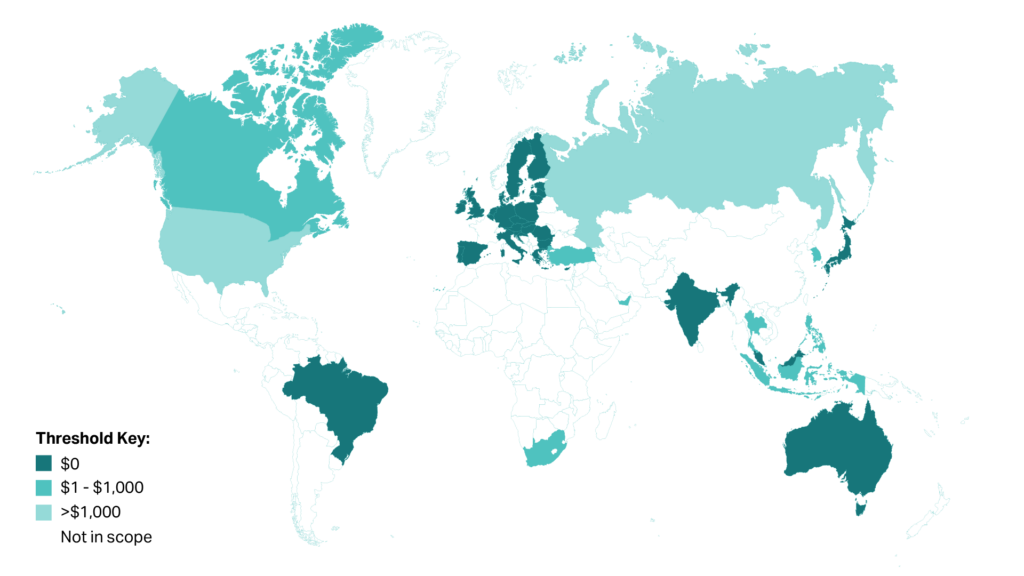
Future Outlook: The Evolving Compliance Landscape
Global Travel Rule frameworks are converging toward stricter, lower-threshold regimes, with active enforcement rapidly replacing legislation as the primary driver of compliance. The UK’s FSMA authorisation regime, the US GENIUS Act, and FATF’s extension of Travel Rule obligations to DeFi protocols collectively signal that the scope of obligated entities is broadening – and the compliance window is closing.
Key Regulatory Developments
|
Regulation
|
Status
|
Implication
|
|---|---|---|
|
Full FSMA authorization replaces AML-only MLR registration. All crypto firms must demonstrate operational KYC/AML programs as a condition of licensing by October 25, 2027.
|
||
|
Zero-threshold Travel Rule for all CASP-to-CASP transfers. EBA guidelines effective December 2024.
|
||
|
First federal stablecoin framework. Stablecoin issuers brought into full AML/KYC obligations.
|
||
|
DeFi protocols with a controlling entity classified as VASPs. 48% of advanced jurisdictions now require DeFi licensing.
|
The more pressing challenge is not legislative coverage but the quality of execution. FATF’s 2025 Targeted Update confirms that supervision and enforcement remain weak even among the 73% of jurisdictions that have passed Travel Rule legislation. State-sponsored actors are exploiting these gaps at an unprecedented scale, and regulators are responding by raising the bar – not just on data collection, but on its accuracy, completeness, and auditability across the full customer lifecycle.
For firms navigating this environment, building institution-grade compliance infrastructure in-house at the pace regulators now demand is neither practical nor cost-effective. Working with an outside KYC/AML service provider, like Integreon, can fill that gap by delivering accurate, scalable, and audit-ready support – from customer onboarding and periodic review through to transaction monitoring and counterparty VASP profiling.
How Integreon Supports Travel Rule Compliance
Integreon integrates directly into client KYC/AML processes and systems, providing specialist capacity across the full compliance lifecycle – from pre-KYC profiling through to ongoing transaction monitoring.
|
Service Area
|
Scope
|
|---|---|
|
KYC Data & Document Sourcing
|
Source KYC data and documents from public records for new and existing clients, including periodic refresh and remediation.
|
|
AML Screening
|
Conduct AML screening and discount false positives for new and existing clients across onboarding and ongoing reviews.
|
|
Full KYC Due Diligence
|
Complete KYC due diligence profiles for PEPs, medium-risk, and low-risk clients.
|
|
Pre-KYC Profiling
|
Complete pre-KYC profiles for non-client relationships, including vendors and counterparty VASPs.
|
|
Enhanced Due Diligence
|
Anti-corruption analysis and sanctions verification on clients’ customers.
|
|
Transaction Monitoring
|
Screen for unusual transactions; monitor activity patterns and alert queues; discount false positives.
|
|
Case & Legislation Tracking
|
Conduct case and legislation searches to support ongoing compliance program management.
|