

Key takeaways:
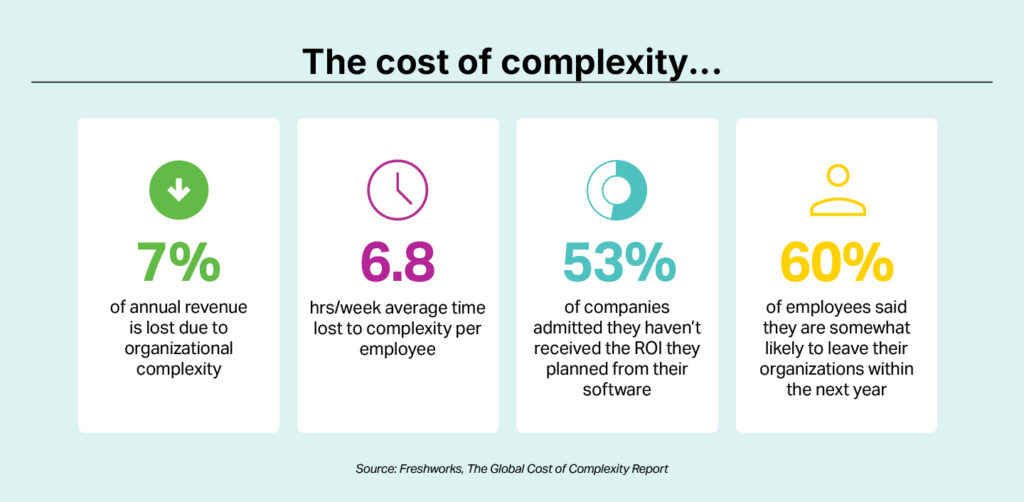
- Organizational complexity reduces revenue by about 7% each year (Freshworks).
- The most successful organizations choose simplicity on purpose, rather than seeing it as only something small companies can have.
- Working with an outside partner to carefully review where complexity is highest, the costs and where it can be reduced helps find opportunities that are missed by internal teams.
In this post:
Share this post:
Subscribe:
Get the latest news and insights from Integreon delivered to your inbox.
Growth is the goal for most businesses. More customers, more market share, more revenue. That logic is hard to argue with, and for most organizations, it’s the right one.
However, growth comes with a hidden cost: complexity. As companies get bigger, they add more people, build more processes, and accumulate more technology. What begins as helpful infrastructure can slowly turn into something difficult to manage and hard to identify.
The impact is clear in the numbers. Research from Freshworks shows that organizational complexity reduces revenue by about 7% each year. That’s about the same as a full R&D budget lost to inefficiency. McKinsey found that mid-level managers in banking spend 60-70% of their time on internal meetings and updates instead of real work. Freshworks also found that employees lose nearly a full workday every week – about 6.8 hours – just dealing with complexity.
These are not rare problems. They are ongoing costs that add up over time.
When faced with complexity, many companies try to fix it by adding more layers, new reports, or extra processes. But this usually doesn’t help. The most successful organizations choose simplicity on purpose, rather than seeing it as something that only small companies can have.
Vanguard is a great example of this approach. The company started with a simple idea: low-cost, straightforward index investing would do better than expensive, complicated options. This decision has helped Vanguard become a market leader over the past fifty years. Today, its average expense ratio is 84% lower than the industry average. This success isn’t luck. By sticking to simplicity, Vanguard creates a cycle where lower costs bring in more assets, which then lead to even greater savings. Their advantage keeps growing each year.
When companies keep things simple, they save money and free up their people to focus on what makes the business stand out. The organizations that do this well move quickly, make smarter choices, and let their best employees work on important projects instead of just managing processes.
Of course, not all complexity can be avoided. Some is built into the way certain businesses work. For example, a global bank dealing with changing regulations or a consulting firm handling many diverse clients at once will always have some level of complexity. The real challenge is not to get rid of all complexity, which isn’t possible or even helpful. Instead, it’s about knowing which parts are necessary and which are just extra.
It’s hard for people inside a company to judge this on their own. An outside partner can offer a fresh, unbiased look at the whole operation, without the habits and blind spots that make some problems hard to see. By carefully reviewing where complexity is highest, what it costs, and where it can be cut, companies often find opportunities that their own teams have missed. The aim isn’t to change everything at once, but to simplify step by step, starting where it will make the biggest difference.
Companies that see simplicity as a key strategy usually do better in the long run, and it’s not by chance. They make clear decisions about which complexity helps the business and which does not, and they keep making those choices as they grow and add new systems. This discipline leads to faster decisions, better focus, and more people working on what really matters.