


For many in-house legal teams, costs associated with litigation and investigations continue to rise, even as new technologies and artificial intelligence (AI) promise greater efficiency. Despite these advancements, document review remains one of the most expensive and time-consuming phases of litigation, often taking a disproportionate amount of the case budget. Many law firms still want to maintain responsibility for all review activities. However, partnering with an Alternative Legal Services Provider (ALSP) is a better way, benefiting both the corporation and their law firm.
The Right Expert, At the Right Time, For the Right Task
To be clear, this isn’t about replacing law firms. It’s about empowering them and empowering corporate legal teams to make smarter, more defensible and more strategic choices, cost effectively. Forward-thinking organizations are recognizing that engaging an ALSP doesn’t diminish legal quality; in fact, it strengthens it.
The escalation of disputes, data volumes, multi-jurisdictional matters and regulatory oversight means legal departments must find ways to stretch budgets without compromising defensibility or outcomes. Despite this, document review and downstream matter support tasks continue to be delivered in largely the same way – high-cost attorneys reviewing large volumes of data, often under pressure and within a rigid billing structure.
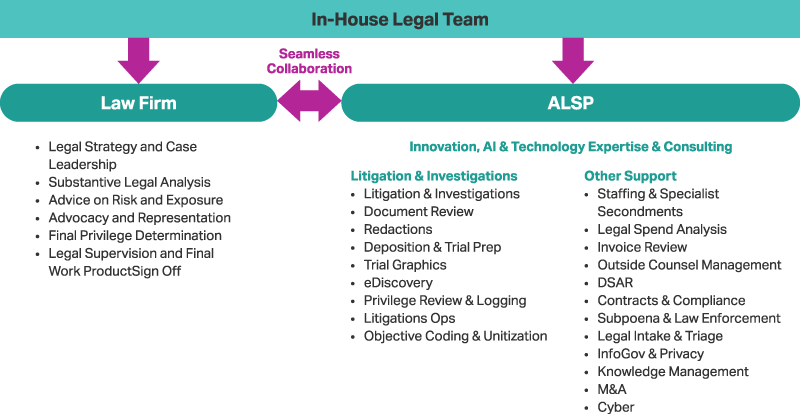
Here’s the truth: law firms are exceptional at legal strategy, advocacy and risk-based decision-making. That is where their time should be spent, not designing workflows, managing reviewers, navigating discovery platforms, recalibrating AI-enabled review cycles or validating first pass AI review output.
Proportionate Defensibility
ALSPs are in the business of operationalizing legal direction with precision, speed, scalability and documented defensibility. ALSP’s are not in the business of legal advice and work under the direction and supervision of counsel. Instructions are provided by counsel, review strategy and workflow is approved by counsel, decisions are validated by counsel, and the quality of final work product is signed off by counsel.
This means:
- Counsel remains accountable and in control
- Work product remains defensible
- Nothing goes out the door without legal oversight
But the workflow design, process optimization and delivery shifts to specialists who do this day in, day out at greater scale and, critically, at a lower cost.
When law firms and expert review providers work as a team, everybody wins:
- The law firm’s high value resources stay focused on the activities their clients intend to pay for like strategic legal
- Law firms benefit from increased capacity, not overburdened with individual reviewer supervision and other time-intensive operational tasks.
- Corporate legal teams benefit from:
- Better spend visibility & cost savings
- Documented defensibility
- Scale so they are better equipped to deliver within strict and/or tight timelines
- A breadth of holistic service offerings
And because ALSPs work under the direction of counsel, their perceived risk of lower quality output doesn’t exist.
The Real Differentiator: Process, Efficiency and Proven Workflow Design
A defensible review is not just about who signs off, it’s about how the work was executed.
Best-in-class ALSPs excel in:
- Appropriate use of AI, analytics, and prioritization methods
- Repeatable, statistically sound QC processes
- Project Management expertise, delivery excellence and bespoke reporting
- Multi-shore and multi-lingual resource deployment
- Driving efficiency through workflow adaptability based on case requirements
AI & Technology Adds Value, When Used Correctly
Consulting with experts on the best use of AI and other technology is critical. A full bells and whistles genAI enabled workflow may sound “cool” but it is not always necessary. It is also critical to defensibility that technology is used responsibly and overseen by humans with the right expertise.
The best outcomes stem from a solution based on a combination of technology and human inputs tailored to the matter at hand. The right combination depends on several nuanced and variable factors such as:
- Volume of data
- Matter type
- Legislative and/or regulatory requirements
- Budget
- Deadline
- Privacy considerations
ALSPs remain at the forefront of innovative solutioning. Savvy legal teams will look to their trusted ALSP partner to help them navigate the ever-changing AI and technology landscape to truly benefit from the value AI and technology can bring, when in the right hands.
What Smart In-House Teams Are Now Asking
Increasingly, legal departments are challenging long-standing delivery assumptions. Here are some questions to consider:
- “Can this review (or other matter support task) be delivered faster and cheaper without reducing defensibility?”
- “Are we using expensive law firm attorneys on outsourceable tasks?”
- “Are project decisions being led by workflow expertise or convenience?”
- “Is our law firm designing processes or simply applying familiar ones?”
- “Are we truly in control of our legal spend?”
- “Have we done an analysis?”
None of these questions threaten counsel. Instead, they promote collaboration, joint transparency and better results.
The Strongest Model Isn’t Necessarily New, It’s Just Evolved
Review and other matter support tasks delivered by law firms alone isn’t “wrong”, it’s just expensive and inefficient in a market that demands more.
Modern teams adopt a hybrid model:
Challenging Tradition Isn’t Confrontational, It’s Good Governance
As litigation budgets grow and regulatory scrutiny increases, corporate leaders have a duty to ensure that every decision around spend serves strategic value.
A thoughtful partnership with an ALSP is not a cost avoidance exercise, but rather:
- A defensible delivery model
- An efficiency gain
- A risk reduction mechanism
- A transparency enhancement
- A strategic extension of legal capability
In a climate where legal spending increases year-on-year, the question is no longer, “Should we be using an ALSP?” but rather “Which ALSP should we partner with?”