

Consultants advising clients. Bankers structuring complex transactions. Lawyers navigating regulatory change. Marketers shaping brand and growth strategy. Analysts turning data into direction. These are today’s knowledge workers – the professionals whose expertise shapes strategy and drives decisions forward.
Expectations for efficiency and productivity are constantly increasing for knowledge workers. And while organizations are earnestly investing in technology and AI tools that promise faster output and easier processes, many fail to deliver true change. Teams are still overloaded, complexity is rising and compliance demands are intensifying.
The issue isn’t whether technology works – it’s whether the operating model around it does.
A structural shift
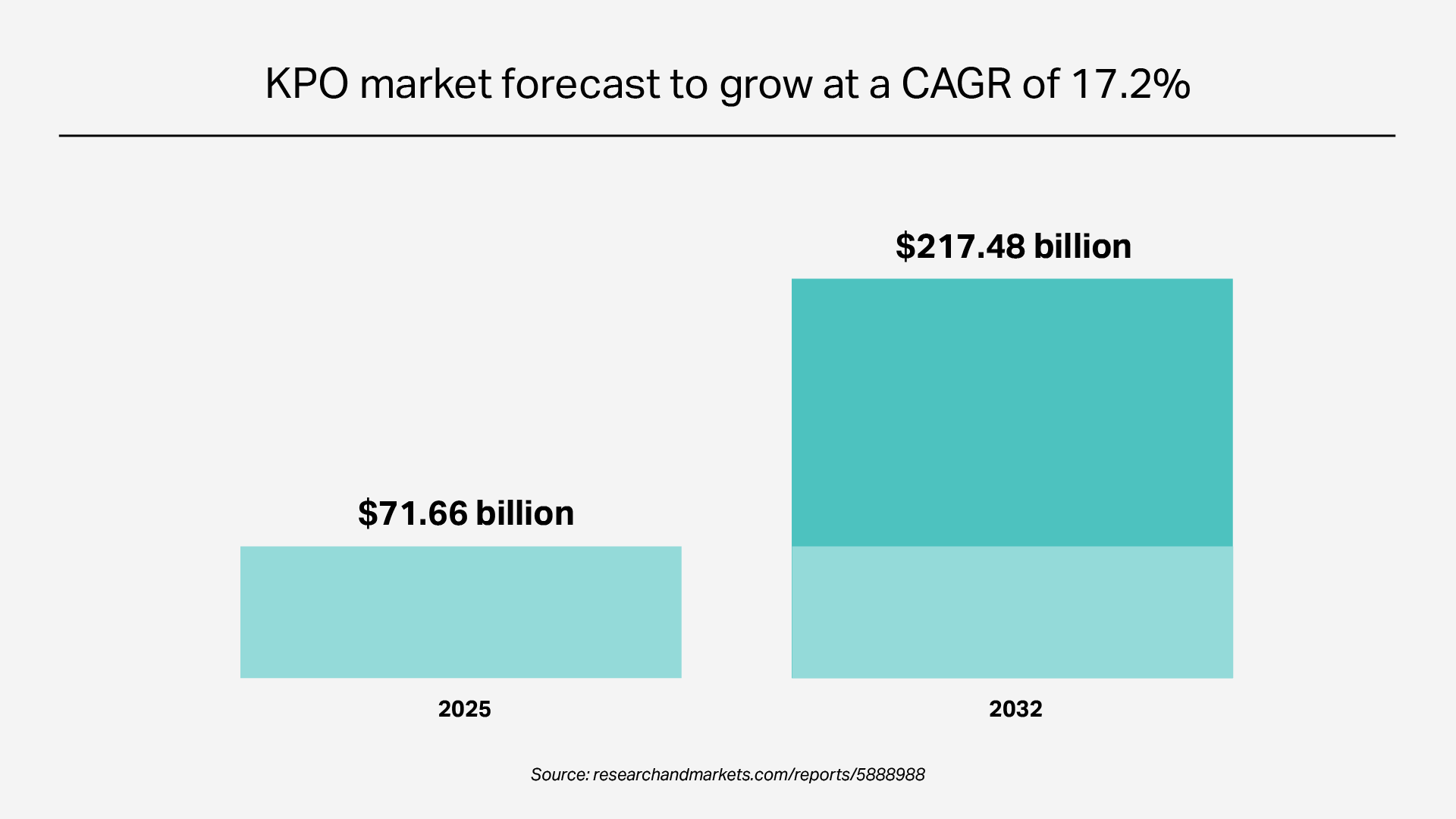
The market reflects this reality. Recent reports on the global Knowledge Process Outsourcing (KPO) market project growth from $71.7 billion in 2025 to over $217 billion by 2032, an over 17% CAGR.
That isn’t incremental growth. It signals a structural redesign in how businesses support knowledge-intensive work. The rising demand for specialized expertise, high quality data, and compelling narratives combined with mounting regulatory requirements and the pressure to deliver faster and more efficiently – means organizations aren’t simply outsourcing tasks. They are rethinking how complex work moves.
Knowledge Process Outsourcing Market
The Production Model Question
- Content management and creative production
- Research and information gathering
- Data management and visualizations
- Creating and updating presentations and decks
- Admin work and back-office operations
- What must stay in-house?
- What can be supported externally?
- Which workflows require domestic oversight?
- Where can global delivery create advantage?
In-House vs. External Support
Firms continue to debate the merits of both models. Either way, it is important to assess and address which model fits within the overall strategy. Pressure to reduce headcount and the desire to build flexible models has been a part of corporate reality for years and is not expected to change any time soon, even with the rise of AI.
With that said, the key is to break down the specific knowledge worker activities to determine the right model for. As an example, KPMG Australia recently announced plans to outsource 200 of their Executive Assistant roles to the Philippines. Clearly, this decision was not taken lightly and required a detailed analysis of multiple factors.
Onsite, Onshore and Global Hybrids
Geography adds another layer of complexity to the picture.
Some workflows must remain domestic due to data residency rules, regulatory mandates, or contractual obligations. In these cases, it is important to build processes with secure infrastructure, strict access controls, and embedded compliance oversight.
The key determination then becomes, whether to work with a provider that operates onsite or onshore -or- whether it is more advantageous to keep the work in-house. This analysis is crucial and can be conducted internally or with the help of vendor partners or consultants to gain more clarity.
Other workflows, particularly repeatable production and research-intensive processes, can benefit from global delivery models. Follow-the-sun structures allow work to progress across time zones without expanding local headcount. This hybrid approach blends onsite, onshore, and offshore teams, reducing costs and increasing efficiency by mapping each workflow to the optimal production model.
Technology in Context
AI is reshaping knowledge work and the processes behind it. And investment in the latest AI tools to streamline and improve workflows is and always will be a focus and goal of every organization. But tools are accelerators – not architecture.
Organizations need to guard against the belief that technology alone is the answer. Productivity compounds when technology is integrated with a support framework that aligns skilled professionals, optimized workflows, geographic flexibility, and governance.
To put it simply: The best results happen when people, process, and technology are combined with intention.
The Next Step
Knowledge workers need a system built for the complexity they operate in – one that enables innovation, mitigates risk, and creates durable advantage. Forward-thinking companies can develop effective support structures by evaluating technology, mapping current processes and optimizing workflows with the right operating model. The next era of productivity will not be defined by a single tool or restructuring initiative. It will be defined by how intentionally organizations design their support architecture.
Learn more about how we support knowledge workers through integrated, secure, and scalable delivery models.
Get in touch