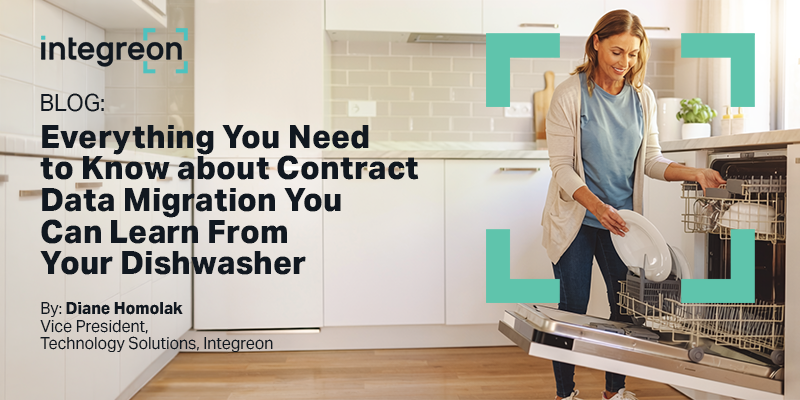

How many of us have roommates or significant others that plop dishes and cookware into the dishwasher without rinsing or scraping? Yet those same folks are dismayed at the sight of those of us who essentially wash our dishes before loading them in the machine. I think we can all acknowledge that the right approach is a compromise. And the same compromise approach applies to data migration.
We discussed some key insights on this topic during our recent Legalweek panel, “Contracts Under the Microscope: Unlocking Insights Through Clean Data and Scalable AI Review,” and we address additional best practices for data migration below.
The Dishwasher: Your Data Receiving Repository
Let’s think about your receiving repository as a dishwasher. Consider what goes in it. You have plates, glassware, cookware and utensils. Each has different properties and different considerations for what level of pre-loading preparation is necessary for effective cleaning.
The same is true of the data being migrated into a Contracts Lifecycle Management (CLM) system. Similar to glassware that needs only a quick rinse if anything, simple stand-alone agreements with active relationships are most likely to be complete and current as to related meta data. These can be reasonably stacked in with minimal review.
Now compare these to your Master Agreements. They are more like utensils. Dried on sauces on spoons and forks can mean the washer can’t fully clean the surface. Often, I’ve had to wash silverware coming out of the dishwasher before I could reasonably use it again on the table. And, just like utensils are critical to eating, Master Agreements form the basis of your future relationships. But, like a spoon with dried-on sauce, they have often sat untouched for long periods. They can lack cohesive tagging or clear parent-child relationships to allow for easy use. Time spent getting your Master Agreements and their progeny clear of debris and cleanly loaded is time worth investing in pre-migration planning and efforts.
AI Can’t Do the Whole Job
Ok, you say, maybe some data does need to be cleansed before a migration effort, but what about AI? It promises to automatically tag data and read content even in files that are a mess. Well, just like that Extra Gold Hyper Strength detergent that claims it can cut through the worst grease and burnt on food, even the strongest AI can only do so much. Anyone who has applied AI to automating their data migration knows that it will give you a good start on basic tagging, but it struggles with pulling answers across parent/child families and definitely works better when applied against a cleaner, consistent data set.
For Sparkling Data Outcomes
Turns out, we can learn a lot about data cleansing and migration from our dishwasher. Sterilizing our documents before a data migration is overkill, but loading straight from use to repository is not the right answer either. Not all data is equal, and higher priority and higher value documents deserve the investment in proper preparation for migration.
While AI is making data cleansing more efficient and less tedious, it cannot replace a bit of upfront scraping and rinsing to preserve your system and get the sparkling repository you aspire to operate. And, partners like Integreon who specialize in using AI to enable efficient data cleansing for migration projects are available to help.