DORA Compliance Part 1: Proactively Meeting DORA Supply Chain Resilience Obligations

Introduction to DORA and its Implications As of Jan.17, 2025, the European Union’s Digital Operational Resilience Act (DORA) became enforceable. This new regulatory framework significantly impacts financial institutions and certain critical Information and Communications Technology (ICT) service providers. It aims to strengthen digital operational resilience across the financial sector through a fundamental shift from reactive to more proactive prevention, ensuring that entities can anticipate, withstand, and recover from digital disruptions, particularly those caused by cyber threats. DORA applies to approximately 22,000 financial entities, including central securities depositories, credit institutions, insurance firms, crypto-asset service providers, investment firms, and various other financial market participants. Its focus extends beyond internal operations to the critical role that third-party vendors–including service providers– play in maintaining operational continuity and resilience. Given the increasing reliance on external vendors—many of which handle sensitive data or integrate deeply into client environments—the risk of disruption is often heightened through third-party relationships. DORA seeks to address these risks, with particular emphasis on vendors whose services involve accessing a client’s digital environment or handling confidential client data. Navigating DORA Compliance: Vendor Due Diligence Simplified Corporate legal departments and law firms have recognized that DORA compliance requires a significant shift in how vendor relationships are managed. Compliance is no longer solely confined to internal controls; it also extends those controls to every third-party partner with access to sensitive systems or data. For legal teams, meeting DORA’s obligations means ensuring that vendors not only meet stringent security and operational resilience requirements but also that they can provide the necessary evidence to support due diligence of these requirements, which is critical for minimizing risks and avoiding penalties. Given the evolving regulatory landscape, organizations are making considerable investments to align their operations and vendor management strategies with DORA’s requirements. For example, vendor selection criteria can be taken into account if a proposed vendor has earned the Financial Services Qualifications System (FSQS) registration certification, a rigorous, comprehensive vendor assessment process developed and accepted by many of the largest financial institutions in Europe. Many organizations are also focused on strengthening their vendor onboarding processes to ensure they can quickly respond to compliance assessments and meet the stringent criteria set by DORA. Vendor Assessments and Compliance Efficiencies Vendor assessments are often a challenge for legal teams, particularly when managing large numbers of complex client relationships. To help ease this process, many service providers have invested in making the vendor onboarding experience as smooth as possible, taking a client-centric approach that considers the unique regulatory and operational requirements of each organization. Whether at the RFP, procurement onboarding, or annual assessment stage, firms have increasingly focused on responding to compliance requests with the documentation required to meet various DORA requirements. Large organization’s legal departments face tight deadlines, whether driven by regulatory timelines or business needs. Vendors that employ cross-functional teams within their organization can address the complexity of DORA-related assessments, often responding to detailed compliance questionnaires within 3-5 business days. This agility allows legal departments to focus on the bigger picture – how their vendors can drive positive business outcomes- while knowing that their vendors are meeting the rigorous compliance standards required under DORA. In summary, DORA significantly impacts digital supply chain resilience obligations by requiring organizations to strengthen the governance and monitoring of third-party relationships, ensuring that vendors meet the highest standards of operational resilience, and addressing the risks posed by vendor disruptions in a more systematic and comprehensive way. Legal departments, compliance officers, and IT teams must work closely together to ensure that the entire digital supply chain is resilient and complies with DORA, with an emphasis on risk assessments, contractual safeguards, and continuous monitoring of critical third-party vendors. Read Part 2 Here
Exterro and Integreon Join Forces to Deliver the Gold Standard in Managed E-Discovery and Document Review Solutions
Partnership combines award-winning data risk management and e-discovery software suite with elite-level data discovery and document review services Frisco, TX and Austin, TX – March 18, 2025 – Exterro, Inc., the global leader in providing data risk management software solutions for e-discovery, digital forensics, and data privacy, security, and governance professionals, and Integreon, a leading global provider of tech-enabled legal solutions, today announced a strategic partnership delivering managed e-discovery and document review services. Together, the two industry leaders now provide enterprise customers with a best-in-class managed e-discovery solution that combines Exterro’s cutting-edge software with Integreon’s deep expertise in managed document review. By utilizing a comprehensive solution from Exterro and Integreon, organizations can effectively manage risk while enhancing efficiency, cost-effectiveness, and defensibility in their e-discovery and document review processes. For organizations involved in multiple litigation matters, Exterro’s single-instance storage solution multiplies the savings as documents can be reviewed a single time and leveraged across any number of cases. By leveraging the managed e-discovery solution from Exterro and Integreon, enterprise clients will benefit from: Cost Reduction & Efficiency: Minimize expenses by consolidating vendors while streamlining legal workflows to boost productivity. Risk Mitigation & Compliance: Ensure defensible, industry-leading compliance across litigation, regulatory responses, and internal investigations, reducing legal risk and potential fines. Enhanced Accuracy & Speed: Improve data processing speed and accuracy, enabling quicker, more informed legal decisions. Simplified Management: Remove the complexity of managing multiple software and service providers with a fully integrated solution. “With the exponential growth of electronically stored information and evolving state and federal regulations, organizations must be more proactive than ever in managing risks – including cyber threats, regulatory compliance, data privacy, and legal exposure,” said Bobby Balachandran, Exterro Founder and CEO. “By combining Exterro’s cutting-edge technology with Integreon’s proven expert services, organizations can effectively find, analyze, and protect against these risks, staying ahead of emerging threats.” Exterro’s AI-driven technology is continuously evolving, providing smarter, actionable insights and automation that many competitors lack. When combined with Integreon’s global team of legal experts, organizations benefit from a uniquely scalable and defensible e-discovery framework that is tailored to their specific needs. “Our clients require sophisticated, technology-enabled solutions to meet the evolving demands of litigation, investigations, and regulatory compliance,” added Phil Goodin, Executive Vice President, Litigation Services at Integreon. “This holistic approach positions Exterro and Integreon as the gold standard in managed e-discovery and document review services, providing an integrated solution that ensures superior results while reducing the burden on in-house legal teams.” About Exterro Exterro empowers organizations to manage data risks with a complete platform for e-discovery, data privacy, cybersecurity and governance, and digital forensics. Unlike any other software provider, Exterro makes it easy for organizations to understand their data and take swift action. Exterro’s AI-driven solutions provide accurate, actionable insights, enabling businesses to ensure compliance, reduce risks, and streamline operations while lowering costs. With Exterro, organizations gain the clarity and confidence needed to address their most critical data challenges. For more information, visit www.exterro.com. About Integreon Integreon is the trusted, global provider of legal, creative and business outsourced solutions to corporations and law firms seeking to expand their capabilities and transform their performance. The company’s 3,500+ professionals provide expert support across a range of managed services—from creative design, content delivery and administrative support to legal and compliance. With global delivery centers on three continents, Integreon delivers round-the-clock service in 50+ languages and is deeply committed to client success, consistently delivering innovative, tech-enabled solutions that improve agility and efficiency to drive business performance. Integreon is owned by EagleTree Capital, a leading New York-based middle-market private equity firm with over $5 billion of assets under management. For more information about Integreon’s range of services, email [email protected], visit www.integreon.com and follow Integreon at LinkedIn, X, and Facebook.
The e-Cla(i)res – An interview with Phoebe Gebre, Chair of the Integreon Lit Technology Committee

The Integreon Litigation Technology Committee is dedicated to the pursuit of knowledge with a specific focus on driving innovation through the combination of technology and legal subject matter expertise. The team sits at the nexus of automation and process engineering and is committed to fostering an environment of innovation and professional development within the larger Integreon community. The E-Cla[i]res recently sat down with Phoebe Gebre Integreon VP – Litigation Services, and Chair of the Litigation Technology Committee. Phoebe, it’s great to chat with you again! I know you and the team have been super busy over the past couple of months. What have you all been up to? Phoebe Gebre: Thanks! It’s been an exciting and productive quarter for the Lit Tech Committee. We’ve been deeply engaged in evaluating emerging GenAI tools, focusing on their potential applications in document review and privilege log workflows. Our team has also been collaborating with industry experts and vendors to ensure we stay ahead of the curve in understanding both the capabilities and limitations of these technologies. In addition to assessing GenAI tools, we’ve been refining our framework for testing criteria as well as looking at use cases in Legal Spaces but beyond document review. Have there been any surprises or unexpected insights during the ongoing GenAI tool assessment? Phoebe Gebre: Absolutely. One of the biggest surprises has been just how fast things are moving—it really feels like the Wild West of GenAI right now. I’m not sure that we expected steady, incremental improvements exactly but some of the changes in a short span of time have been surprising. Companies have been acquired, and we have observed other companies shifting their focus away from document review and focusing on trial prep, for example. Recently, we have also been looking at built-in Gen AI functionality in many proprietary review tools. I think now the expectation is that all review platforms are going to have some Gen AI functionality. Another notable shift is that clients who once hesitated to adopt Active Learning, predictive coding, or single-instance review are now actively exploring these tools and smart workflows, asking informed questions, and seeking ways to improve efficiency. Even those still in a wait-and-see phase for implementing GenAI functionalities are re-evaluating their workflows, looking for opportunities to streamline processes and optimize their approach. Crucially, the cost of running GenAI has dropped significantly, especially compared to what we were seeing in mid-2024, so that has been an interesting development as well. What are the Lit Tech committee’s priorities for 2025? Phoebe Gebre: In 2025, our focus will be on two main areas: Integrating AI into Document Review Workflows – As we transition from assessment to implementation, our focus will be on seamlessly incorporating AI tools into document review workflows. We’ll explore the many ways GenAI can enhance efficiency while also establishing clear guidelines on when—and when not—to use it. Understanding its limitations and identifying scenarios where it may not be the most effective solution will be just as critical as leveraging its strengths. Use cases beyond document review – I think that AI and GenAI are going to be game changers for data disposition, both when it comes to identifying physical boxes that need to be shredded and removed from the warehouse, for example, as well as ESI that no longer needs to be retained. Traditionally, document retention and disposal have been manual, time-consuming processes prone to human error. With AI, we can analyze massive volumes of records quickly, identifying which documents have met their retention period and flagging them for secure destruction. GenAI takes this a step further by interpreting unstructured data—scanning file names, metadata, and even document content to classify records more accurately. This means organizations can automate much of the decision-making process, reducing the risk of keeping unnecessary records (which increases compliance risks) or accidentally shredding something that should be retained. Given the growing focus on information governance and data minimization, leveraging AI for defensible disposition is not just efficient, it will be essential. How has chairing our Lit Tech committee impacted your perspective on innovation and AI in the legal industry? Phoebe Gebre: Leading the I4 Committee has reinforced just what an exciting and transformative time it is for the legal industry. It’s also been incredibly rewarding to collaborate with professionals such as Miguel Villalobos, Scott Bien and others on the committee, as well as individuals across the industry who share a passion for shaping the future of legal tech. What we continue to find is that human oversight is critical. Even as these tools become more powerful, their effectiveness still depends on legal professionals guiding, refining, and validating their outputs. This reinforces the importance of rigorous testing and adaptability before full-scale implementation. Ultimately, I see AI not as a replacement but as a powerful tool that, when used strategically, can elevate the work of legal professionals and create new opportunities for efficiency and insight.
Marketing Operations: Workflow Strategies that Work

From campaign planning to content creation, the most successful marketing teams run on well-defined workflows that drive efficiency and consistency. Integreon is partnering with the Financial Communications Society (FCS) to present a free webinar on Monday, March 10, featuring senior marketers from leading financial institutions who will share how they optimize operations, leverage technology, and refine processes to scale seamlessly. Our panelists include: Lilly Raymond, Head of Marketing Strategy, MarTech and Operations, Prudential Financial Franchesca Maddalena-Napp, Executive Director, Head of Solutions Marketing, UBS Additional panelist to be announced Moderated by: Murray Joslin, EVP of Creative & Business Solutions, Integreon. Join us for a candid discussion on the strategies, tools, and partnerships that keep workflows agile and adaptable. We’ll explore questions like: How do leading firms design workflows that balance precision with flexibility? What role does technology play in streamlining execution? How can you future-proof your processes for growth and change? Register today to join us and gain actionable insights to elevate your marketing operations. Register Now Panelist Lilly RaymondHead of Marketing Strategy, MarTech and OperationsPrudential Franchesca Maddalena-NappExecutive Director, Head of Solutions MarketingUBS Moderator Murray JoslinEVP, Creative & Business SolutionsIntegreon
Legalweek 2025
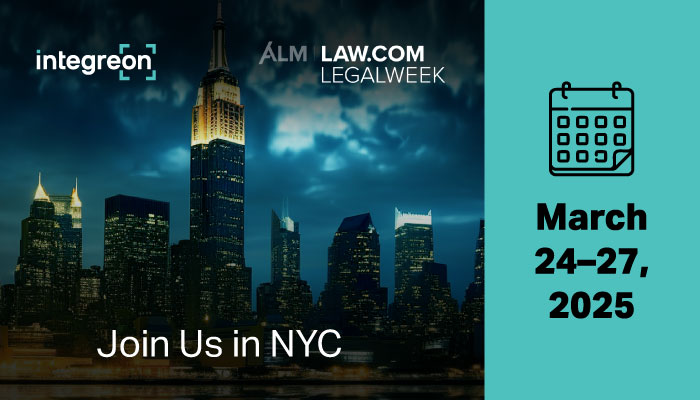
Join Integreon at Legalweek Legalweek, being held March 24 through March 27 in New York City, is the largest legal tech conference globally. It’s where the legal community convenes to explore emerging trends, spotlight the latest tech and share knowledge on how to best navigate the industry’s seismic shifts. Integreon, the trusted, global provider of tech-enabled solutions to corporations and law firms, will be there and is moderating a panel on March 26th, 2pm, “Beyond Document Review: Expanding AI’s Role in Modern Litigation.” Don’t miss this session, and schedule time today to meet with us during the conference to learn how to expand and scale your work with our expert-delivered legal and compliance. Connect with Integreon Integreon will be on site all week and would welcome the opportunity to connect.
Integreon Receives Highest Marks in Annual Client Satisfaction Survey
High net promoter scores reflect Integreon’s commitment to its clients, investment in technology and robust account management program February 6, 2025 – (AUSTIN & LONDON) – Integreon, a leading global provider of tech-enabled outsourced legal, creative, and business solutions, today announced the results of its annual Client Satisfaction (CSAT) Survey, which surpassed the high marks the company received over the last four years. With an impressive Net Promoter Score (NPS) of 66, the company showcases its unwavering commitment to excellence in client delivery and innovation. First introduced in 2020, the survey invites clients to share their feedback on the quality and value of their relationship with the company. Since the inception of the CSAT program, the NPS question, “How likely are you to recommend Integreon?” has been included in the survey. Bain & Company, the originators of the NPS, indicate that a score over 20 is “favorable” and anything above 50 is “excellent”. Integreon’s company score was 66, and each business unit scored in the sixties, with Integreon litigation services achieving a 77, the highest score to date. This significant accomplishment underscores the trust and loyalty Integreon clients have in the company and its people and solutions. “Integreon has proven to be an invaluable partner over the years,” said Mike Lucas, Chief Information Officer, Wilson Sonsini. “Their team consistently delivers essential services that our employees rely on daily. With a deep understanding of our needs, Integreon demonstrates impressive adaptability and expertise, ensuring they meet our evolving demands effectively.” In addition to the outstanding NPS, all other survey questions received higher marks than in previous years. The most sizable increases were seen in questions pertaining to Integreon recommending enabling technology and other innovative approaches, proactively seeking opportunities to provide insights and solutions that enhance or improve service delivery, and satisfaction with the frequency and quality of business reviews and ongoing communication. “The annual CSAT results provide the strongest proof point supporting Integreon’s reputation for strength and longevity of our client relationships,” said Subroto Mukerji, CEO of Integreon. “Achieving the highest NPS since the program launch is a testament to the quality and hard work of our team members and drives our dedication to continues improvement.” These scores reflect Integreon’s ongoing efforts to stay ahead of industry trends and deliver exceptional value to its clients. It also reflects the company’s investment in a robust account management program that provides clients with an additional layer of support and client service. About Integreon Integreon is the trusted, global provider of legal, creative and business outsourced solutions to corporations and law firms seeking to expand their capabilities and transform their performance. The company’s 3,500+ professionals provide expert support across a range of managed services—from creative design, content delivery and administrative support to legal and compliance. With global delivery centers on three continents, Integreon delivers round-the-clock service in 50+ languages and is deeply committed to client success, consistently delivering innovative, tech-enabled solutions that improve agility and efficiency to drive business performance. Integreon is owned by EagleTree Capital, a leading New York-based middle-market private equity firm with over $5 billion of assets under management. For more information about Integreon’s range of services, email [email protected], visit www.integreon.com and follow Integreon at LinkedIn, X, and Facebook.
Integreon’s approach to responsible AI
Integreon’s Chief Technology Officer, John Wei, shares how Integreon is leveraging artificial intelligence to transform workflows, enhance client outcomes, and drive innovation across industries. Discover AI’s role in legal and compliance solutions, creative and business services, and more.
Integreon’s approach to AI strategy
Explore Integreon’s innovative approach to artificial intelligence with insights from John Wei, our Chief Technology Officer. In this video, John outlines how Integreon is shaping its AI strategy to drive innovation, streamline processes, and deliver exceptional results for clients across industries. Learn how AI is becoming a cornerstone of Integreon’s solutions, from enhancing legal and compliance services to optimizing creative and business processes. This video highlights our forward-thinking approach to leveraging AI as a transformative tool for modern challenges.