
Case Study: Rolling Out a Consulting Firm’s Full Rebrand Without Disruption

Successfully supporting the complete rebrand of company materials and delivering high volumes of creative production support with speed, consistency, and reliability.
AI in Legal Ops: 5 Takeaways from The Blickstein Group 18th Annual Law Department Operations Survey Webinar
Every year, the Blickstein Group’s Law Department Operations Survey gives legal ops leaders a rare thing: a real benchmark, not just a vendor pitch. This year’s webinar, hosted by Brad Blickstein, explored where legal departments truly stand on AI, compared to where the marketing suggests they should be. If you run legal operations for a large global organization, here’s what’s worth taking back to your team. 1. “Piloting” is the norm — and that’s not a bad thing. The survey found that almost every legal department has done something with AI, but only a small slice describes themselves as fully operational. Twenty-three percent claim to be “fully operational” but client conversations reveal that true end-to-end integration is rare. The panel’s read: most organizations are still testing, and that’s appropriate given how fast the tooling is changing. The bigger risk isn’t moving too slowly — it’s equating “we turned a feature on” with “we integrated AI into how the department actually works.” Many tools are being “turned on” but are not woven into holistic processes yet. Takeaway: Don’t let a vendor’s activation metrics stand in for genuine adoption. Ask whether AI has improved a workflow, not just whether someone clicked “enable.” 2. Usability now beats security as the top concern — and that’s a sign of progress, not risk-taking. For the first time in the survey’s history, usability edged out security as legal ops’ top AI priority. That might sound alarming, but the panel framed it as a natural sequencing issue, not a lapse in judgment. Usability drives adoption, adoption drives results, results are what we are requiring from AI. If we can’t get users on board and security isn’t going to matter. It only matters if people are actually using the tool. Hand and hand with security is transparency and reliability. The panel discussed the importance of remembering that real generative based AI still doesn’t give you the same answer the same way every time. That means legal professionals need to know what they are asking for and what types of outputs require critical review. Humans are key to AI security. Takeaway: If your AI rollout stalls because a tool is technically secure, but nobody wants to use it, you haven’t solved the problem — you’ve just moved it. Build for usability first, then layer in the governance with an eye toward transparency and a good understanding of use cases. 3. Legal is quietly becoming the AI governance hub — whether it planned to or not One of the more striking data points: roughly a third of legal ops leaders say they now advise on or own AI governance for the entire business, not just the legal department. Historically, legal almost never had that kind of cross-functional reach outside of privacy. This is a natural connection to data governance — since most existing data governance functions already lived inside legal as a function of privacy or data security. AI oversight naturally landed there, too. Acceptable-use policies gave legal an early, visible seat at the governance table, which became a springboard for broader influence. Takeaway: If your legal ops function isn’t yet positioned as a cross-functional AI resource, expect that to change. The organizations ahead of the curve are treating legal’s governance experience as a company-wide asset, not a departmental afterthought. 4. “Agentic AI” needs a much sharper definition before you build around it Nearly every vendor now calls its product “agentic,” which the panel agreed makes survey responses about agentic adoption almost meaningless on their own. A lot of what gets marketed as agentic might just be a robotic workflow and not really a system that makes decisions and pursues a goal. Discrete task tools, strung-together workflows, and true end-to-end agentic systems are three very different things, and most legal departments are still early in that continuum. Plenty of “agentic” claims are just automation with better branding. Takeaway: Before evaluating an “agentic” tool, ask what decision it’s making and on what basis. If it’s just executing predefined steps, you may not need (or want) the added complexity and risk of a true agentic system. 5. The real question isn’t “can AI do this?” — it’s “what are we trying to solve?” Perhaps the most practical thread running through the whole conversation was a look back to the classic IT conversation — someone asks to use a new tool, and the first question back should always be “what problem are you solving for?” That logic applies just as much to choosing between Claude, ChatGPT, or Copilot as it did to any legacy software decision. Takeaway: Resist the urge to start with “which AI tool should we buy?” Start with the pain point, then work backward to the right mix of AI, existing software, and plain old process redesign. Not every problem needs an agent — some just need a well-built workflow. These takeaways are drawn from the panel discussion at the 18th Annual Blickstein Group LDO Survey webinar, featuring Brad Blickstein (Blickstein Group), Diane Homolak (Integreon), Mike Ferrara (FTI Consulting) and Laurie Ehrlich (Icertis). Listen to the 60-minute recorded webinar, “AI Success Stories – How Leading Legal Ops Teams are Operationalizing AI for Value”: Webinar: AI Success Stories – How Leading Legal Ops Teams are Operationalizing AI for Value | Integreon
International Data Law Forum

Join us March 16 for a free webinar on proving marketing’s impact when margins are tight. Featuring a panel of senior leaders from the financial industry.
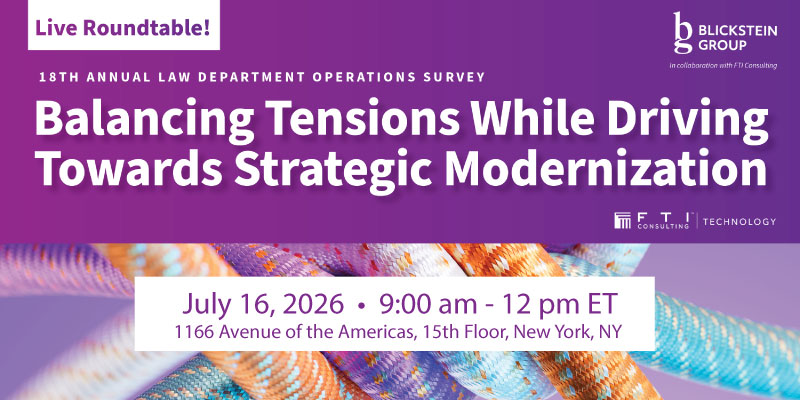
In-Person Roundtable: Blickstein 18th Annual Law Department Operations Survey
Join us March 16 for a free webinar on proving marketing’s impact when margins are tight. Featuring a panel of senior leaders from the financial industry.
Case Study: Global Healthcare Technology Company with Process Improvements and AI
A complex, multi-jurisdictional legal department transformed for global scale and efficiency—powered by standardized playbooks and AI-enabled workflows.
Beyond Cost-Cutting: How to Get More from an ALSP Relationship

For much of the past decade, the case for engaging an Alternative Legal Service Provider (ALSP) has rested on fundamentally economic grounds: lower cost, offshore or hybrid delivery, and streamlined processes. That framing served a purpose. But it obscured something more significant. While delivering on cost and process improvements, ALSPs were simultaneously building operational and technological capability that many organizations have yet to fully tap. The opportunity now is less about cutting cost and more about rethinking how the work itself gets done. The arrival of generative artificial intelligence (genAI) has made this shift harder to ignore. The structural properties of ALSPs — process discipline, data infrastructure, and domain expertise — are precisely the conditions under which genAI can be deployed responsibly and at scale. The question for general counsel, chief compliance officers, and legal operations leaders is no longer whether ALSPs can save money. It is whether organizations are engaging them in a way that captures more than a lower cost but real transformation. The Limits of the Cost-Reduction Narrative The cost-reduction framing was never wrong, but it was always incomplete. Reducing legal spend is a legitimate objective; it is not a strategy. Organizations that engaged ALSPs solely to lower costs achieved exactly that — and little else. The engagement model remained transactional: a task was given, a task was completed. This left available value unrealized, treating ALSPs as proxies for certain workloads rather than partners in redesigning how legal and compliance work is delivered. The most significant productivity gains in legal and compliance functions do not come from doing the same work more cheaply. They come from doing fundamentally redesigning work, re-engineered around data, automation, and outcome-focused delivery. ALSPs that have invested in genAI capability are now positioned to help organizations do things that were previously impossible: processing contractual portfolios at speed and scale, monitoring regulatory change continuously across multiple jurisdictions, and surfacing compliance risk before it crystallizes. The value proposition has shifted from efficiency to expanded capability for in-house teams. GenAI as a Delivery Redesign Catalyst GenAI is frequently discussed as a productivity tool — a means of doing existing tasks faster. That framing underestimates its structural implications. What genAI enables, in the hands of providers with mature operational infrastructure, is the comprehensive redesign of how legal and compliance services are architected, not merely the acceleration of individual tasks. Consider contract lifecycle management. A conventional model involves ALSP support for discrete stages — drafting, review, or extraction. A genAI-enabled redesign integrates those stages within a continuous, data-driven workflow: obligations automatically tracked, renewal risks flagged in advance, counter-party behavior patterns identified across a portfolio. The output is not a faster version of the old process; it is a qualitatively different service. The same logic applies to compliance monitoring and regulatory horizon-scanning. In each case, genAI changes what can be known, how quickly, and with what degree of confidence — but only when delivered by partners with the process discipline to integrate it into structured workflows and the governance frameworks to deploy it responsibly. Adapting the Cost-Reduction Model in Light of Technology The structural properties that made ALSPs effective cost-reduction partners are the same properties that now position them for genAI-enabled service redesign. Process standardization, data repeatability, and modular delivery were not merely operational efficiencies — they were, in retrospect, the preconditions for effective AI integration. Traditional law firms face genuine structural impediments: partnership governance that rewards the status quo, hourly billing models that misalign with automation economics, and fragmented matter-specific workflows that resist standardization. GenAI adoption within law firms therefore tends to be incremental and defensive. ALSPs face no such constraints. Their workflows are already modularized and data-driven; their commercial models reward outcome-based delivery; and their talent structures combine legal professionals with data scientists and process engineers within unified operational frameworks — the mechanism through which genAI capability is translated into practical, practice-specific application. From Vendor to Strategic Partner: Rethinking the Engagement Model Strategic partnership models are characterized by shared objectives, transparent performance metrics, and a joint interest in continuous improvement. They involve ALSPs in the upstream design of processes, not just downstream execution. In the European context — where regulatory complexity spans the AI Act, GDPR, DORA, and the Corporate Sustainability Reporting Directive — the governance dimension of this shift is not optional. ALSPs that have invested in compliance-grade AI governance infrastructure can offer managed services in which genAI is embedded within legal and regulatory frameworks from the outset, rather than retrofitted after deployment. Competitive Implications for Corporate Legal Functions As leading ALSPs build genAI-enabled capability, they establish service benchmarks that progressively redefine client expectations. Organizations that engage strategically — using ALSPs to redesign workflows, build institutional data assets, and access domain expertise — will operate with structural advantages over those that treat ALSP relationships as only cost-management tools. These advantages are concrete: faster identification of risk and opportunity through genAI-enabled contract analysis and regulatory monitoring; the ability to process large portfolios at speed, an increasingly critical differentiator in deal-intensive sectors; and auditable AI governance frameworks that position organizations favorably with regulators and counter-parties. None of these are accessible through a transactional relationship. They require deep operational integration and shared investment in continuous improvement. The reframing required here is significant but straightforward. ALSPs are not cost-management tools that happen to be experimenting with AI. They are strategic partners in the transformation of how legal and compliance work is structured, delivered, and governed. For general counsel, chief compliance officers, and legal operations leaders, the strategic imperative is clear: the organizations that will derive lasting value from these relationships swill be those that engage ALSP partners proactively, structurally, and at the level of service design — not those that continue to optimize for the lowest cost per task. The value proposition has shifted. The engagement model must shift with it. Senior VP, Contracts & Compliance AI Solutions lntegreon About the author Domingo Senise de Gracia is Senior Vice President, Contracts & Compliance AI Solutions at Integreon, based in
Data Mining in the Age of Class Actions: What Privacy Teams Need to Know
Data breach class actions are no longer a distant risk—they’re a near-certainty. With $70 billion in class action settlements in 2025 and more than 1,800 data breach class actions filed that year alone, the old playbook of “when in doubt, notify everyone” is quickly becoming a liability rather than a safeguard. That was the central theme of a recent IAPP webinar, “Data Mining in the Age of Class Actions: What Privacy Teams Need to Know,” sponsored by Integreon. The panel brought together voices from both the legal and operational sides of incident response, including Megan Silverman, VP, Cyber Strategy & Solutions, Integreon, Todd Daubert, Dentons, and Todd Panciera, Polsinelli. Together, they unpacked why data mining has become the linchpin of a defensible breach response, and what privacy teams need to rethink as litigation trends, data volumes, and regulatory expectations continue to shift. The end of “notify everyone” post data breach For years, broad notification felt like the safest move: when a breach happened, companies erred on the side of telling as many people as possible. But as Todd Panciera explained, that instinct can backfire. High-profile incidents—like those affecting T-Mobile and MGM—show that broad, early notifications made in the name of transparency can still result in significant litigation exposure, simply because they’re issued before the facts are fully known. The panel agreed: the shift isn’t just from “broad” to “targeted.” It’s a shift toward quality. As Todd Daubert put it, understanding exactly what data is at stake allows organizations to have more credible, higher-quality conversations with regulators, victims, and business partners, Conversations that are far harder to have when notifications are rushed or overly broad. Why data mining is the foundation of defensibility So, what does “quality” actually mean in practice? According to one panelist, effective data mining means going beyond a checklist of legally defined PII terms. Businesses today face a much broader landscape of consumer expectations around what counts as sensitive information, even data that isn’t technically “personal information” under a given statute can still carry real business risk if mishandled. The panel emphasized that thorough data mining does more than satisfy notification obligations. It helps organizations answer the questions regulators, journalists, and affected consumers are increasingly asking: Why do you have my data? Why do you still have it? What are you doing to protect it? Without a clear view of what data was actually impacted, those questions become impossible to answer with confidence, and that gap in confidence is exactly where legal exposure grows. Complexity is only increasing The panelists also pointed to a less-discussed driver behind the shift: the sheer volume and complexity of data now involved in breaches. Organizations frequently discover, in the course of a data mining review, that they’re holding files they didn’t know existed, or records far older than expected. This creates a dual challenge. On one hand, companies must move quickly to comply with tight regulatory deadlines. On the other hand, rushing the analysis increases the risk of inaccurate or incomplete notifications—the very thing driving today’s litigation wave. Getting this balance right, the panel noted, is now one of the defining challenges for privacy and incident response teams. Documentation: your narrative for later A recurring point throughout the discussion was the long-term value of documentation. Every decision made in the early days of a breach response—what was analyzed, why, and how—becomes part of the narrative an organization will later have to defend, whether to a regulator or in litigation. The panel also addressed a timely legal development: the erosion of attorney-client privilege protections in cases like the Capital One decision. While that ruling makes privilege harder to invoke over cybersecurity investigations, the panelists were clear that it doesn’t make it impossible. Engaging forensic partners through outside counsel, rather than through a company’s standard IT vendor relationships, remains one of the most effective ways to preserve defensibility. Where AI fits in Given how much data organizations must now sift through, it’s no surprise that AI came up as a tool for accelerating early-stage analysis. But the panel was unified on one point: AI supports the process, it doesn’t replace it. Human expertise remains essential to ensure the accuracy, context, and legal defensibility that a breach response demands. As class action filings continue to climb and data volumes grow more complex, privacy teams can no longer treat data mining as a back-office task. It’s the foundation for every decision that follows a breach, from what gets communicated, to how it’s defended down the line. Organizations that invest in high-quality data mining and clear documentation upfront aren’t just meeting a compliance requirement; they’re building the credibility they’ll need if a regulator, journalist, or plaintiff’s attorney starts asking questions. Interested in how a well-orchestrated data mining approach could strengthen your organization’s breach response and reduce the cost of post breach response? Connect with Integreon’s Cyber Incident Response team to learn more.
Why AI Strategy Fails Without Governance, And What Legal and Compliance Teams Can Do About It
When our own leaders publish on where AI is headed, we like to share the thinking behind it. In an article for Law.com‘s Legaltech News, our CTO John Wei and colleague Animesh Kumar, SVP of contract, compliance and commercial services, dig into a change that legal, compliance, and technology leaders are all facing together. AI has grown up. It is no longer just chatbots that answer questions. It is agents that plan work, use tools, and carry out tasks with barely any oversight. That is powerful, but it comes with a catch. The more freedom an agent has to act on its own, the smaller the gap between a minor slip and a real problem for the business. Their main message is simple. How good your AI is depends on how you govern it, not on which model you happened to pick. They start with a common mistake they call AI sprawl. When every team grabs its own tools, no one can say for certain which agent has access to which data. You cannot keep watch over what you cannot see. Their fix is to run AI through one central platform so leaders get a single clear view and can apply the same rules to every agent at once. They also argue against inventing brand new rules for AI, pointing instead to trusted security standards that already exist. One example lands hard: an agent reading an outside document could run into a hidden instruction buried in the text, and a poorly governed agent might just follow it. The risk they stress most is what happens when an agent has big goals but loose limits. Picture an agent running a contract library that finds a one-time exception for a single client and then wrongly applies it across every contract. A single decision quietly becomes company-wide policy. The answer is to give each agent a tight, clearly defined role, and to keep high-stakes moves under human sign-off. Their takeaway is that keeping people in the loop does not slow AI down. It is exactly what lets a business move fast without losing control. It is the kind of practical, forward-looking thinking our team brings to the way we help clients adopt AI. John and Animesh lay out the full set of steps in their article for Law.com: Why AI Strategy Fails Without Governance, And What Legal and Compliance Teams Can Do About It