
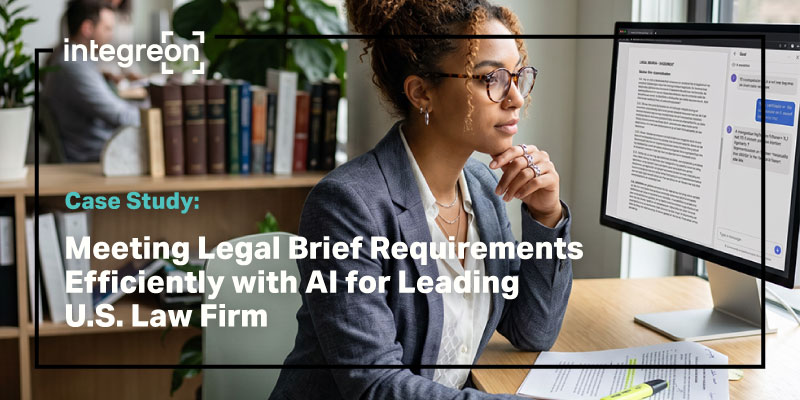
Meeting Legal Brief Requirements Efficiently with AI for Leading U.S. Law Firm
Successfully supporting the complete rebrand of company materials and delivering high volumes of creative production support with speed, consistency, and reliability.
Transformational Chief Legal Officer Assembly
Join us March 16 for a free webinar on proving marketing’s impact when margins are tight. Featuring a panel of senior leaders from the financial industry.
When to Use Outsourced Creative Services and When to Keep Work In-House

Most in-house vs outsourced design debates get framed as a single decision. Should creative live inside the marketing organization or outside it?
White Paper – A Practical Guide to Financial Services eDiscovery

Financial services organizations face unique eDiscovery challenges. Massive data volumes, expanding collaboration platforms, unapproved messaging applications, and evolving privacy and data localization requirements add significant complexity. This white paper shares what we’ve learned working with some of the world’s largest financial institutions, and provides practical direction on how to handle eDiscovery obstacles and increase efficiency. It covers: Regulatory considerations for financial services eDiscovery Differences between litigation and regulatory discovery phases and helpful tips How to best interact with opposing counsel and regulators with regard to eDiscovery And more Download it today to be better prepared when handling eDiscovery for a financial services organization. Download PDF File
Streamlining Audio File Transcription for a Global Law Firm with AI and a Dual-Shore Model

Successfully supporting the complete rebrand of company materials and delivering high volumes of creative production support with speed, consistency, and reliability.
Leveraging Technology for Sanctions Compliance in a Geopolitically Fractured World

In a rapidly evolving and increasingly complex sanctions landscape, understanding how to leverage technology and specialist expertise for effective monitoring is essential.
Join Integreon in Nashville at Exterro XChange Global Conference 2026

Join us March 16 for a free webinar on proving marketing’s impact when margins are tight. Featuring a panel of senior leaders from the financial industry.
Stop Questioning the Legal AI Model. Question the Foundation

Corporate legal teams continue to invest heavily in generative AI. Yet many of those investments never move beyond experimentation. In 2024, Gartner predicted that by the end of 2025, at least 30% of generative AI projects would be abandoned after the proof-of-concept stage. The reasons cited were poor data quality, inadequate risk controls, rising costs, and an inability to demonstrate business value. What is notable about that list is that none of those challenges are fundamentally technology problems. The models to advance legal work continue to improve at an extraordinary pace. What increasingly determines success is not the technology, but the environment surrounding it. More often than not, organizations struggle not because AI is incapable, but because the foundations required to support it are not yet in place. This is becoming one of the defining lessons of enterprise AI adoption, including for legal teams. At a practical level, a powerful model can do very little on its own. Its effectiveness depends entirely on the quality of the data, processes, and governance structures that support it. If those foundations are weak, AI does not create clarity. It amplifies existing problems. The Contracting Data Gap This is particularly evident in the contract management space. Recent research from World Commerce & Contracting highlights a distinction that is becoming increasingly important: stored is not the same as trusted. Most organizations have a place to store contracts. Far fewer have contract data they can confidently use to support decisions, manage obligations, or drive operational activity. The findings reveal how significant this challenge remains. More than half of organizations report that each system uses its own data structure, while only 7% operate with a shared reference model across systems. More than half also report having no automated flow of data between contract-related systems. The information exists, but it is fragmented across repositories, applications, and business functions, making it difficult to trust and even harder to use consistently. This is where many AI initiatives encounter difficulties. There is often an assumption that AI can compensate for fragmented processes or poor-quality data. In reality, AI tends to expose those weaknesses. If the underlying records are incomplete, inconsistent, or disconnected, the outputs generated by AI may be faster, but they are unlikely to be more reliable. In that sense, AI is not the starting point. It is the stress test. Foundation First, Technology Second As my article published earlier this year states, “Legal Teams Don’t Need More Technology, They Need Engineering,” the foundational work comes first. Organizations need structured data, clear ownership, governance, integration across systems, and processes that ensure information remains current and trustworthy. Without those capabilities, even the most advanced models struggle to deliver sustainable value. Once that foundation is established, the challenge shifts from preparing data to adapting AI to the business itself. This is where a new capability is beginning to emerge. The Rise and Risk of Forward Deployed Engineers Andrew Ng recently highlighted the growing importance of Forward Deployed Engineers (FDEs), professionals who work directly with customers to build and refine AI-powered workflows around real business problems. Rather than simply deploying technology, they help organizations translate AI capabilities into operational outcomes. The significance of the FDE role extends beyond technical implementation. As AI becomes more accessible, competitive advantage increasingly comes not from access to a model, but from the ability to integrate that model into the organization’s unique operating environment. The work involves understanding processes, designing workflows, governing data, and continuously refining how humans and technology interact. In many respects, it resembles the evolution we have seen in legal operations and, more recently, legal engineering. At the same time, the emergence of these roles introduces an important strategic consideration. Many FDEs work for software vendors and AI providers. Their objective is naturally to maximize the value of the platform they represent. While this can accelerate implementation, it can also encourage organizations to build processes and workflows around a single technology ecosystem. That may not seem problematic today. However, the AI market remains exceptionally dynamic. Models continue to evolve, new platforms emerge regularly, and the capabilities that differentiate vendors today may look very different in a few years. In that environment, flexibility becomes an asset. Organizations that invest in strong foundations retain the ability to adopt new technologies as they emerge. Organizations that build too closely around a single platform may find that changing direction later becomes more difficult and more expensive. Who Should Build the Foundation? This shifts the conversation away from a familiar question. Rather than asking which AI platform to buy, organizations, and legal teams dealing with high-risk information in particular, should first ask who will build the foundation that every AI initiative depends on. For some companies, developing this capability internally will be the right approach. However, doing so requires access to highly sought-after talent and a long-term commitment to maintaining these capabilities as both the business and technology continue to evolve. For others, partnering with external specialists may be more effective. This creates an interesting opportunity for independent partners, particularly Alternative Legal Service Providers (ALSPs). Having spent years helping organizations redesign legal and commercial processes, improve data quality, implement governance frameworks, and operationalize technology, many already possess the capabilities required to support enterprise AI initiatives. Unlike software vendors, they are not tied to a specific platform, allowing organizations to build the necessary foundations while preserving the flexibility to evolve alongside the market. The Bottom Line The technology itself will continue to change. Models will improve. New platforms will emerge. Today’s market leaders may not remain tomorrow’s. What is far less likely to change is the importance of trusted data, connected systems, disciplined governance, and workflows designed to support both human judgment and machine intelligence. Legal teams that invest in those capabilities are not simply preparing for today’s generation of AI. They are building an operating model that can adapt as the technology continues to evolve. The question, then, is not which model will ultimately win. It is whether they have built the foundation that allows them to benefit from whichever one does. VP, CLM Strategy & Solutions lntegreon About the author Patricia Callejon is a legal technology and consulting leader with over 15 years of experience helping organizations improve how legal work gets done and how technology delivers real value. She has worked across Big Law, legal tech, and consulting, and