
Cyber Incident Response Data Mining Review Vendor Selection: What to Look For, What to Avoid
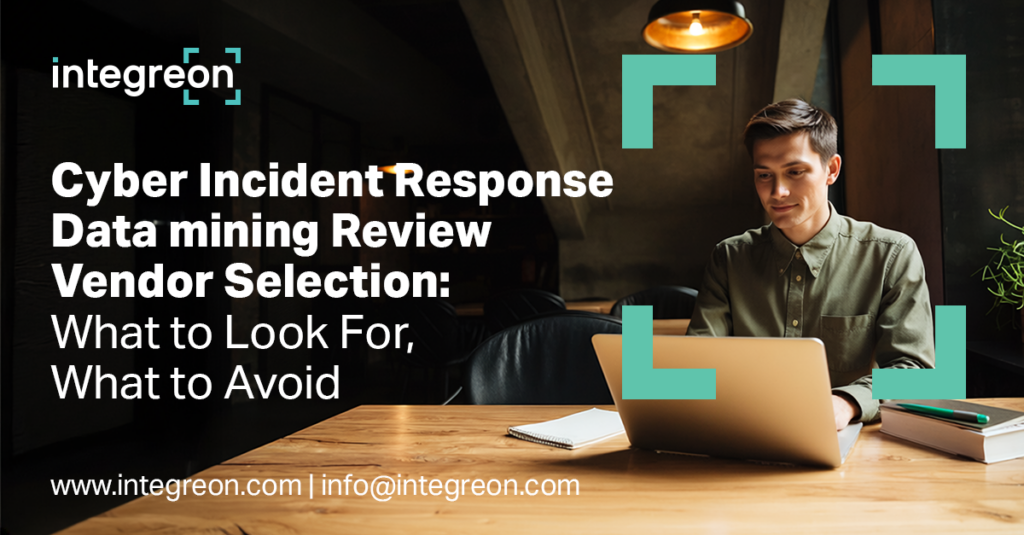
Selecting a Cyber Incident Response (CIR) review vendor isn’t just a procurement exercise; it’s a strategic decision that can determine how quickly and accurately your organization identifies threats, contains breaches, and recovers from attacks. Even though these decisions happen under pressure, often during an unexpected and stressful incident, the fundamentals of sound judgment still apply. The right partner will demonstrate competence, transparency, and operational maturity from the very first interaction. What to Look For 1. Demonstrated experience and operational maturity Vendors with long-standing experience in CIR work have typically refined their processes for defensibility, accuracy, and consistency. Longevity in this niche matters. Make sure they have experience supporting real-world breach investigations and have case studies demonstrating results provided to recent clients. 2. A strong data mining and review focus Some companies try to cover the entire incident-response lifecycle, but the best partners are those with deep specialization in document review and data mining. Focused expertise means better accuracy, efficiency, and scalability. They should also offer support for structured and unstructured data. 3. A well-structured scoping call with Counsel, Client, and the Vendor A strong vendor will orchestrate an information gathering call to ensure they understand your needs fully. The call should include an operationally knowledgeable representative. This person should: Ask thoughtful questions about data size, data composition, the client’s industry, jurisdictional concerns, and the data owner’s role. Be able to anticipate potential challenges based on the details provided. Avoid making early promises. Instead, they explain which factors could increase costs or extend timelines. Be willing to educate counsel and the client on the CIR review process. Demonstrate empathy for the client’s situation and maintain a calm, solution- focused approach. Be easy to schedule with, and follow the call with an accurate, detailed summary and clear next steps. Provide a project estimate tailored to the specific details of the matter. 4. Clarity on who performs the work Ask potential partners who is slated to do the review. Many vendors rely heavily on subcontractors or even “sub subcontractors” for core review tasks. The strongest vendors maintain in-house expertise, especially when it comes to these types of roles: Data specialists Project managers Review managers Reviewers A unified internal team can best ensure consistency, quality control, and accountability. What to Avoid 1. Prices that are far lower than competitors without clear guardrails Beware of early bids made before the vendor knows: How many documents will be produced? What types of documents are included in the review? Which regulatory schemes apply? Any vendor offering unusually low pricing without a cost control commitment may raise prices significantly later. Transparent pricing and predictable costs are key to avoiding surprises, especially during a major incident when volumes could spike. 2. Promises of fast turnaround before reviewing the data Not all documents are equal. While automation can accelerate certain workflows, some file types such as handwritten notes, low quality scans, or large unstructured PDFs will require extensive manual review. Conversely, uniformly formatted spreadsheets may be processed quickly. Any vendor claiming fast timelines before seeing data is making assumptions that could undermine accuracy or lead to missed deadlines. 3. Claims that their “powerful” or “alternative” review platform can solve everything Strong tools exist (Machine Learning platforms like Canopy, LLM powered tools like Relativity DBR), but: None eliminate the need for human review, No platform is preconfigured for the unique regulatory and data composition realities of your case. Tools should support the process and not be presented as a substitute for human expertise. 4. Sales pitches centered on being the cheapest, fastest, or most convenient option Low cost, speed, and convenience are appealing, but should never overshadow these critical deliverables: Accuracy Defensibility Responsiveness The ability to handle unique project needs and anticipated data volume. The right vendor prioritizes doing the work correctly, then focuses on efficiency. Choosing a cyber incident response data mining vendor is a strategic investment in your organization’s resilience. The right partner accelerates investigations, strengthens detection, and reduces risk. The wrong one adds friction, cost, and uncertainty. By focusing on transparency, performance, scalability, and IR‑centric capabilities—and avoiding prices without guardrails, promises of fast turnaround, and claims that tech can solve all—you can select a vendor that empowers your team when it matters most. Integreon has what you need in a CIR data mining partner. Be ready for when an incident happens and contact our Cyber Solutions experts to schedule a time to learn more. About the author Cara Dempster is VP, Customer Operations for Cyber Solutions at Integreon. In this role, she helps lead data mining delivery, technology, and innovation for our clients.
Law Department Operations Roundtable: Balancing Tensions While Driving Towards Strategic Modernization
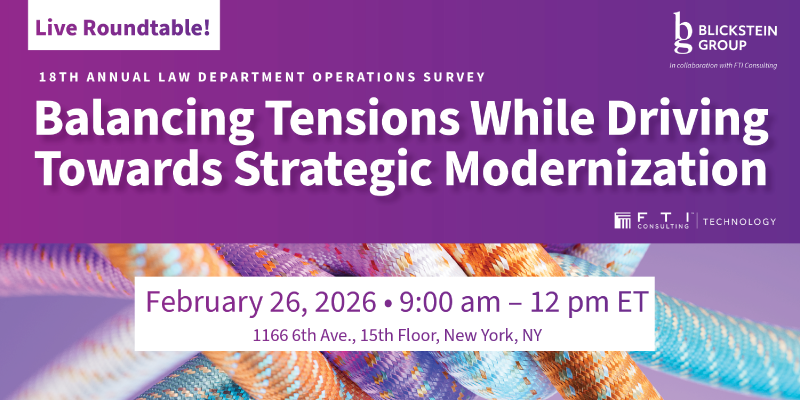
Join Integreon at the Law Department Operations Roundtable! February 26, 2026 – New York City 9:00 a.m.-12 p.m. EST Join a discussion with corporate legal operations leaders in New York City to discuss key findings from the 2025 Blickstein Group Law Department Operations Survey, to include: Detailed analysis of the 2025 Law Department Operations Survey results and what they signal about the next phase of legal ops maturity Discussions on expanding mandates and shrinking budgets, tech maturity vs. tech reality, and the new spend equation across law firms and ALSPs Strategies for modernizing through technology and deciding where AI and automation truly move the needle Real-world examples of how departments are reallocating work among in-house teams, law firms, ALSPs, and lower-rate alternatives Plus, you’ll have the opportunity to network with some of the world’s top legal ops professionals. Register Now To download the 18th Annual LDO Survey Report, please visit www.LDOSurveyReport.com.
Legalweek 2026
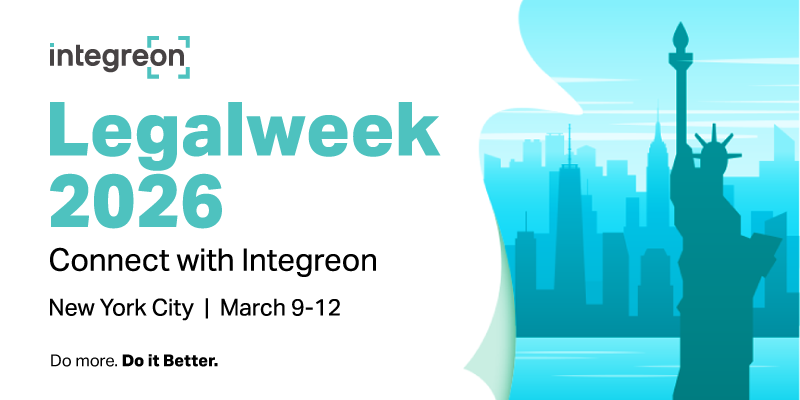
Join Integreon at Legalweek 2026! March 9-12, 2026 North Javits Center – New York City Described as the “leading conference for the legal technology industry,” and one that “hits all the marks for information, education, and networking”, Legalweek transcends the traditional conference model to deliver unparalleled expertise, networking, and technological innovation. Integreon will be there. Don’t miss our panel discussions: Tuesday, March 10 Contracts Under the Microscope: Unlocking Insights Through Clean Data and Scalable AI Review Speakers: Deanna Fowler, Senior Innovation Manager, Troutman Pepper Hamilton Sanders LLP Diane Homolak, Vice President Technology Solutions, Integreon Leandro Doca, VP | Head of CCM for Americas SBU | Global CCM Head of Transformation, Capgemini Wednesday, March 11 Cross‑Border ESI Transfers: Minimizing Friction and Compliance Risk Speakers: Miguel Villalobos, Senior Director of Integrated AI & eDiscovery, Integreon David Cohen, CEO, Access to Justice Denise Backhouse, Shareholder, eDiscovery Counsel, Littler Mendelson PC Set time to meet with us today: https://www.integreon.com/contact-us/ Conference information and registration
Upskilling and Partnering Ease the Way to Successful AI Implementation
The future of marketing isn’t about managing more technology. It’s about creating flow, where ideas, data, and design move together, not apart.
Beyond Formatting: How Technology and AI Are Transforming Legal Word Processing

The future of marketing isn’t about managing more technology. It’s about creating flow, where ideas, data, and design move together, not apart.
How to Get the Most from Agentic AI for In-House Legal Teams: Quality over Quantity

The future of marketing isn’t about managing more technology. It’s about creating flow, where ideas, data, and design move together, not apart.
Consero Legal Operations Forum Februrary 2026

Join Integreon at the Consero Legal Operations Forum! February 10–12, 2026 Four Seasons Hotel, Westlake Village, CA We’re pleased to sponsor Consero’s Legal Operations Forum in California in February. This gathering of legal operations leaders will include active panel discussions and engaging networkring opportunities. Integreon’s Valerie Charles, VP, Legal Operations, will lead a discussion on “Legal Operations and the Regulatory Landscape: Navigating Change at Scale.” For more information, visit: https://consero.com/events/corporate-legal-operations-forum-8/
Litigation & Investigations: Why Savvy Corporate Legal Teams Should Challenge Traditional Models
The future of marketing isn’t about managing more technology. It’s about creating flow, where ideas, data, and design move together, not apart.