
Legal AI Adoption Tips And Takeaways From Dot-Com Bubble

In the late 1990s and early 2000s, the dot-com bubble was in full swing. The internet exploded, the stock market boomed, and then came the market correction and the fall of many internet-focused companies. At the time, I was serving in a senior legal role for Hewlett-Packard, which gave me a unique vantage point from the legal strategy and business perspectives. Today, those of us who worked in legal and technology during that time are experiencing an undeniable sense of déjà vu. The current investment frenzy surrounding legal artificial intelligence looks remarkably similar to the dot-com bubble. So, what happens when capital allocation overpivots during the emergence of transformative technologies? Every massive technology cycle, just like this one in legal tech, creates legitimate long-term winners, irrational capital allocation and secondary distortions across the broader ecosystem. By examining past market behaviors, corporate legal functions and law firms can navigate the current environment without falling victim to market turbulence. Modern Indicators A mature market typically follows a steady, calculated progression of growth. In the current legal AI market, however, we’re seeing clear characteristics of speculative bubble behavior, as valuations are far outweighing traditional revenue metrics. For instance, Harvey AI reached a reported $3 billion valuation in 2025, with subsequent funding indications suggesting a valuation in excess of $11 billion, all on fairly modest revenue.[1] In March, Legora announced that it raised capital at a valuation north of $5 billion.[2] Meanwhile, generalist AI developers are rapidly entering legal, as highlighted by Anthropic rolling out its Claude for Legal solution[3] alongside a corporate valuation of $965 billion.[4] Beyond the billions in valuations, marketing strategies reflect classic bubble behavior. Legal AI vendors are producing Hollywood-caliber marketing campaigns — featuring A-list celebrities such as Jude Law[5] — to try to court law firm partners and chief legal officers. This mirrors the time when enterprise software-as-a-service companies wooed chief information officers with stadium concerts and open bars. When marketing budgets and valuations outpace foundational enterprise integration, market correction usually follows. Historical Echoes The fact that the dot-com bubble burst did not invalidate the transformative effect of the internet. The internet fundamentally changed how global commerce is transacted and how information is consumed. The bubble was a product of timing, inflated valuations and unrealistic adoption timelines. Capital simply flooded the market ahead of sustainable economics. When the Nasdaq peaked in March 2000 and subsequently lost roughly 78% of its value by 2002, the financial carnage was severe.[6] Yet, companies like Amazon.com Inc., Google LLC and Salesforce.com Inc. grew to be industry titans. On the other hand, companies like Pets.com and Webvan experienced rapid collapse. Pets.com became the ultimate symbol of speculative excess by spending heavily on highprofile branding before reaching maturity and sustainability.[7] Webvan collapsed because infrastructure costs and premature adoption assumptions outpaced market maturity, even though its core thesis of online grocery delivery became mainstream 20 years later.[8] A similar dynamic is playing out today. AI is genuinely transforming how content is created, managed and monetized across the global legal landscape. It’s automating manual processes that historically required human intervention due to poor workflows, infrastructure silos or bad data quality. The massive capital entering legal AI reflects the expectation that technology will reshape the delivery models of a $1 trillion industry.[9] However, just as in the early stages of the internet boom, the market will inevitably yield many casualties and only a few scaled winners. Likely Winners and Losers The Platform Contenders A fierce competition is underway to become the industry’s foundational legal AI platform. Legal-focused platforms like Harvey AI, Legora, CoCounsel and Litera are fighting for market dominance, and they’re facing competition from established enterprise software giants like Microsoft Corp., ServiceNow Inc. and Workday Inc., which aim to be the central hub connecting and managing automated AI tasks across the whole company. Concurrently, generalist large language model providers are entering industry verticals to avoid commoditization, as seen with Anthropic and OpenAI. There will be a few scaled winners of the platform race that can consolidate market share. This consolidation can also accelerate from the merging or acquisition of competitors. Point Solutions Point solution vendors are focusing on narrow use cases like contract creation, redlining and document review, or deep industry verticals like clinical trial agreements. To be successful, they must be exceptionally easy to use, execute targeted tasks well and avoid being absorbed by larger platforms. Many point solutions will struggle to scale quickly enough to sustain operations in an ecosystem changing at an exponential rate, and will likely experience the greatest initial fallout. Infrastructure Providers During the dot-com era, infrastructure providers like Cisco Systems Inc., Oracle Corp. and Akamai Technologies Inc. experienced massive growth. Even when individual internet startups failed, the underlying demand for networking, databases and hosting exploded. The massive overinvestment in telecom infrastructure and data centers was eventually absorbed by the market. Today, hardware and infrastructure providers like Nvidia Corp., Microsoft and Amazon Web Services are reaping the rewards of the AI boom; they remain positioned for growth regardless of which individual legal AI applications survive. The Advisory Ecosystem Every technology bubble creates a secondary economy of consultants, integrators, trainers and transformation advisers competing to monetize the transition. In the late 1990s, traditional consulting firms like Accenture PLC, KPMG Consulting and Razorfish rapidly repositioned themselves as internet transformation advisers. Today, major service providers, global consultancies and alternative legal service providers are similarly pivoting to lead AI enablement efforts. The Real Gaps: Why Workflow Lags Behind Hype A major challenge that comes with any transformative technology is the gap between marketing hype and the realities of deployment. In the late 1990s, many people believed that brick-and-mortar stores would close, newspapers would cease to be published and businesses would digitize instantly. Sure, the technology worked, but organizational change took years to fully take effect. Within the legal sector, several systemic frictions are slowing widespread adoption: Economic models: Legal AI pressures traditional law firm billable hour structures, requiring a nuanced evolution of firm-client economic relationships.
How to Escape Pilot Purgatory and More Efficiently Roll Out AI

The legal industry is currently witnessing a massive divergence between the speed of technological evolution and the reality of departmental adoption. Technology is simply advancing faster than legal departments can effectively implement it. The next wave – agentic AI – promises to automate and execute multi-step workflows and change the nature of in-house legal work end-to-end. The problem is that 52% of legal departments are still in pilots with generative AI, with fewer departments (23%) saying they are fully deployed and operational, according to the latest Blickstein Group Law Department Operations (LDO) survey. Meanwhile, 20% of legal departments are actively deploying AI agents for contract negotiation, with another 40% exploring the technology. Given the rapid pace of technology change, legal departments need a strategy for assessing, piloting and rolling out – or moving on – quickly and effectively. The Middle-Mile Problem Why do pilots stall? The root cause is often the “middle mile” problem. Organizations frequently treat AI as a standard software purchase or a tool to be installed rather than a fundamental workforce transformation. This traditional approach is failing for three reasons: Fragmentation: An overwhelming number of providers has created a tech stack that cannot communicate with itself. Safety Brakes: Security and accuracy concerns remain a significant hurdle for 44% of legal professionals, acting as a permanent brake on deployment. The Shiny Object Trap: The rush to explore agentic models without a foundational data strategy leads to pilots that look good in a vacuum but fail in production. To bridge the gap between piloting and deployment, legal leaders need a new roadmap. A Roadmap to Escape Pilot Purgatory 1.- Establish a Rigorous Assessment Framework With a flood of new technologies hitting the market, it is easy to get lost chasing the latest flashy feature. Successful departments apply the discipline of an objective framework: survey the market, prioritize high-value use cases, and apply consistent criteria to every tool. If a tool doesn’t meet the threshold, move on quickly. 2.- Accept a Continuing Work-in-Progress The legal tech stack will never be complete. Many teams fall into paralysis by analysis, waiting for the perfect, all-in-one solution. In reality, decisions must be made to solve today’s challenges, with the understanding that these tools may be re-evaluated or replaced in two to three years as the landscape shifts. 3.- Leverage Trusted Partners to Shortlist You don’t have to vet every tool yourself. Law firms and Legal Service Providers (LSPs) are exposed to a wide array of technologies across different clients. Leverage their experience to shortlist vendors. Often, a provider can run a pilot within your environment or conduct a joint proof-of-concept, saving your internal team hundreds of hours in the vetting phase. 4.- Define Success with Go/No-Go Timelines Every pilot must have a shelf life. Before a single login is created, establish what success looks like using quantifiable metrics. Set a strict period for testing and reporting. At the end of that period, there are only two options: Go or no-go. 5.- Prioritize Quantifiable ROI Use Cases Focus on pilots that directly reduce outside counsel spend or internal hours on high-volume tasks. If you cannot establish a current baseline or demonstrate time savings against your current state, do not waste time piloting it. For example, rather than exploring AI, map out a specific process like M&A due diligence where agents handle the first 80% of the heavy lifting. 6.- Empower Change Champions Technology doesn’t fail; adoption does. Identify change champions within your team – those who are naturally tech-curious – to lead the pilot. Their enthusiasm generates the internal momentum necessary to push a tool past the pilot phase and into the daily workflow of the rest of the department. Agentic Adoption Realities The most common reason pilots fail is a misalignment of expectations. Many leaders expect 100% automation and are disappointed when a human still needs to intervene. Setting reasonable expectations for agentic adoption requires mapping out the process and understanding the priority areas where agents will offer the most lift and where humans will supervise most effectively. Success looks like agentic AI handling the first 80% of the work, leaving the final, high-value 20% for human experts. In addition, the coming wave of agentic AI requires legal departments to calibrate how they are thinking about data and workflows. Consider piloting a data cleanup agent. The most sophisticated LLM in the world is useless if your contracts are trapped in disorganized repositories or inconsistent formats. By focusing on the data layer first, you ensure your legal AI has a clean foundation to act upon. The 2026 Deadline Many legal departments are still in pilot mode, but we are rapidly approaching a tipping point. By the end of 2026, the gap between piloters and deployers will become a significant competitive disadvantage. Those who have built an AI-enabled workforce will operate at a speed and cost-basis that traditional departments simply cannot match. The goal for the modern GC isn’t to have the most expensive or best AI; it’s to have the best AI-enabled workforce. To get there, you have to stop piloting and start flying. Vice President, Enterprise Solutions lntegreon About the author Scott Bien, J.D., is Vice President, Enterprise Solutions, at Integreon. He earned his law degree from Northern Kentucky University, Salmon P. Chase College of Law.
Why HIPAA Compliance After a Breach Demands More Than You Think

When a healthcare organization suffers a cyberattack, the instinct is to focus on containment. But as this article makes clear, a parallel legal obligation kicks in almost immediately — one that most organizations are underprepared for. Under HIPAA’s Breach Notification Rule, a covered entity cannot simply assume a ransomware attack or unauthorized access didn’t cause harm. The law presumes a breach occurred, and the burden of proving otherwise falls entirely on the organization. That proof requires a highly specific, documented risk assessment — and this article breaks down exactly what that means in practice. You’ll learn how the four-factor risk assessment works and why each factor demands granular, record-level analysis rather than high-level policy responses. The article explains why even incidents without confirmed data exfiltration still trigger the breach presumption, and why organizations that assume otherwise are taking a serious compliance risk. The piece also tackles the pressure of the 60-day notification deadline — a hard clock with no exceptions for large or complex datasets. Critically, it explains how the “constructive knowledge” standard means that delays in completing your analysis don’t push back the start of that clock, and how rolling notifications can help organizations manage compliance without waiting for a complete picture. Perhaps most importantly, the article makes the case for why data mining — though never mentioned by name in HIPAA — is functionally required in any large-scale breach response. Organizations that can systematically analyze affected data, document their findings, and notify in waves are far better positioned in an OCR investigation than those who wait. Read the full article in the IAPP newsletter here: Why data mining is functionally required after a HIPAA breach | IAPP
The Toyota Test for Legal Outsourcing

If you work in a corporate legal department, manage outside counsel relationships, or make decisions about legal operations and technology, this article reframes a question most legal leaders are asking wrong. The piece uses Toyota Motor North America’s Partnership Award to Integreon — an alternative legal services provider — as a lens for examining what successful legal outsourcing actually looks like. The argument is sharp and operational: moving legal work to an outside provider isn’t the achievement. Gaining command over that work is. Key takeaways: Outsourcing without discipline is just distance. If the process stays opaque, standards go unmeasured and lawyers keep chasing repeatable work, the legal function hasn’t transformed — it’s just relocated the burden. Your real standards are revealed by your exceptions. If a contract position or approval requirement is abandoned 90% of the time, it isn’t actually your standard. Managed services worth paying for should surface that gap, not paper over it. Capacity is the core constraint — and it isn’t solved by moving work. Legal departments can cut outside counsel spend, invest in technology and still trap lawyers in low-value review cycles. The fix is redesigning the work, not just reassigning it. Automation follows discipline, not the other way around. AI won’t rescue departments that haven’t measured or governed their own workflows. It accelerates what exists — useful only if what exists is worth accelerating. The article’s broader argument is that legal work should be held to the same operational standards top performing companies apply everywhere else: defined, measured, improved continuously and automated only when the process can support it. Read the full article in Corporate Counsel Business Journal here: https://ccbjournal.com/blog/the-toyota-test-for-legal-outsourcing
FT Innovative Lawyers Global Summit

Join us March 16 for a free webinar on proving marketing’s impact when margins are tight. Featuring a panel of senior leaders from the financial industry.
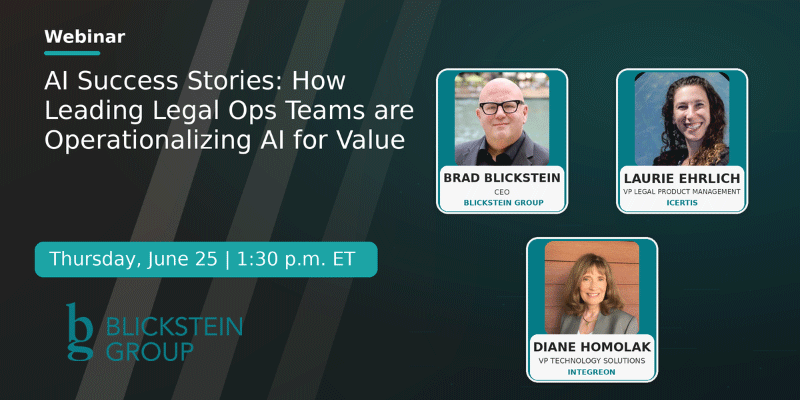
Webinar: AI Success Stories – How Leading Legal Ops Teams are Operationalizing AI for Value
Join us March 16 for a free webinar on proving marketing’s impact when margins are tight. Featuring a panel of senior leaders from the financial industry.
Webinar: Data Mining in the Age of Class Actions

Join us March 16 for a free webinar on proving marketing’s impact when margins are tight. Featuring a panel of senior leaders from the financial industry.
LegalTechTalk, Intercontinental O2 London 2026

Join us March 16 for a free webinar on proving marketing’s impact when margins are tight. Featuring a panel of senior leaders from the financial industry.