
AI & Emerging Cyber Risk

AI is capable of incredibly sophisticated cybersecurity attacks, but threat actors are also using it to make old-school social engineering techniques even more effective.
Webinar: Legal Intake, Reimagined: Your Front Door to Legal Services Efficiency (CLE-Eligible)
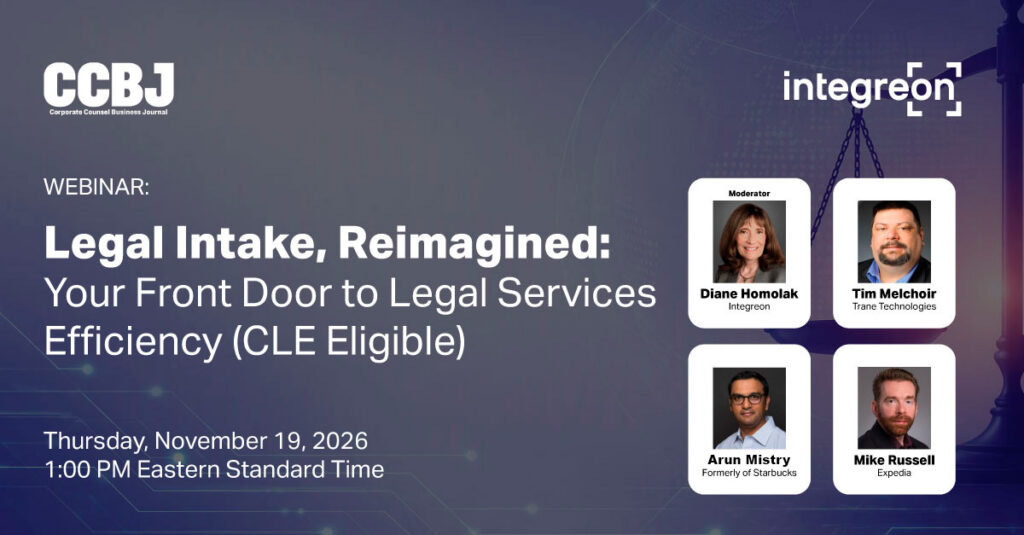
Date: Thursday, November 19, 2026 Time: 1:00 PM Eastern Standard Time Duration: 1 hour Speakers: Diane Homolak – VP, Technology Solutions, Integreon (Moderator) Tim Melchior – Sr. Legal Operations Analyst, Trane Technologies Arun Mistry – Formerly Director, Global Legal Operations, Starbucks Mike Russell – Head of Global Legal Operations, Expedia Legal teams are under pressure to respond faster, improve the experience of their internal clients and create more capacity for higher-value work. Yet requests still arrive through email, chat, spreadsheets, shared inboxes and other disconnected channels. Join us in this educational webinar hosted in conjunction with Corporate Counsel Business Journal (CCBJ) that will show legal leaders how to evaluate their intake environment, identify practical opportunities for AI and automation and build a more effective front door to the department. For more information and registration: Go to event page
Travel Rule 2025-2026: Why Crypto KYC is No Longer Optional

For crypto business and financial firms, meeting stricter transparency rules requires a compliance infrastructure that is accurate, scalable, and audit-ready.
The Attacker’s Cost Curve: Looking Back at Philadelphia, Looking Ahead

Legal spend management is no longer just about reviewing invoices. Inconsistent processes, unreliable data, spreadsheets, and limited financial visibility can prevent legal departments from controlling costs and demonstrating value. Strong programs combine technology with effective governance, trusted data, analytics, and accountability to give legal leaders clearer insight into spending and opportunities to improve.
No One In Legal Departments or Law Firms Can Measure AI Efficiency at the Matter Level

Marketing has better AI measurement than ever. Here’s how to translate it into a business case CFOs and CEOs will actually fund.
AI Made PowerPoint Faster. Should your consultants be making slides at all?

For professional services firms, the next phase of AI adoption should be about using AI tools where they genuinely improve workflow.
The EU AI Act Didn’t Go Away. It Just Moved to 2027.
Most U.S. general counsel have the same read on the EU AI Act right now: it’s delayed, so there’s time. Our Managing Director of Legal & Compliance Solutions, Claire Frazer, makes the case in a recent piece for Law.com that this read is only half right, and the half that’s wrong is the costly one. The Omnibus package adjusted the timeline, not the destination. High-risk requirements now phase in through December 2027 and August 2028, depending on the system. But AI literacy requirements have applied since February 2025, and Article 50 transparency obligations, including disclosure and machine-readable marking of AI-generated content, already took effect in August 2026. The runway got longer. The obligations didn’t disappear. Two assumptions are worth retiring along with it. First, EU establishment isn’t the trigger, use is. The Act can apply to any organization whose AI outputs are used in the EU, with or without a European entity involved, which means the operative question isn’t “do we operate in the EU,” but “where do our AI systems’ outputs actually land.” Second, legal AI gets no automatic pass for being a professional tool. Contract review and e-discovery aren’t exempt by category. Classification turns on the purpose and function of the specific use case, not on whether a lawyer is in the loop, which makes use-case mapping far more important than simply labeling something “legal technology.” The piece also reframes what governance should mean in practice: risk classification against Annex III use cases, verifiable data segregation, documented human-oversight protocols, and audit-ready records of how AI outputs were validated. Claire’s sharpest point may be the simplest one: regulatory classification should be the floor of the governance conversation, not the ceiling. An organization should be able to answer how its confidential information is handled and who’s accountable for AI output, regardless of whether a given workflow technically qualifies as high-risk. For in-house teams evaluating an ALSP partner right now, that list of questions is a useful one to borrow directly, starting with: can the partner show the risk mapping, not just describe it, and is there a named owner for AI Act compliance, or is it diffused across IT, legal, and operations in a way no one actually owns? It’s also the foundation our Compliance Support team is built around: governance that’s operational today, not a policy document waiting for 2027. Read Claire’s full piece on Law.com: General Counsel Are Underestimating the EU AI Act’s Timeline
The Threat Actor Playbook Has Shifted from Files to Rows

Legal spend management is no longer just about reviewing invoices. Inconsistent processes, unreliable data, spreadsheets, and limited financial visibility can prevent legal departments from controlling costs and demonstrating value. Strong programs combine technology with effective governance, trusted data, analytics, and accountability to give legal leaders clearer insight into spending and opportunities to improve.